Use case · Contested sustainment
Replan Sustainment When Route and Stock Change
Connect usable stock, movement capacity, time windows, mission demand, and command authority so a changed route or inventory fact produces an inspectable replan rather than another reconciliation cycle.
Narrated film · 1:12
One transport disappears. Three planning views disagree.
Watch the shared model expose what changed, compare the remaining options, and leave the revised plan for an officer to approve.
An authored scenario that explains the idea. Read the story and its limits.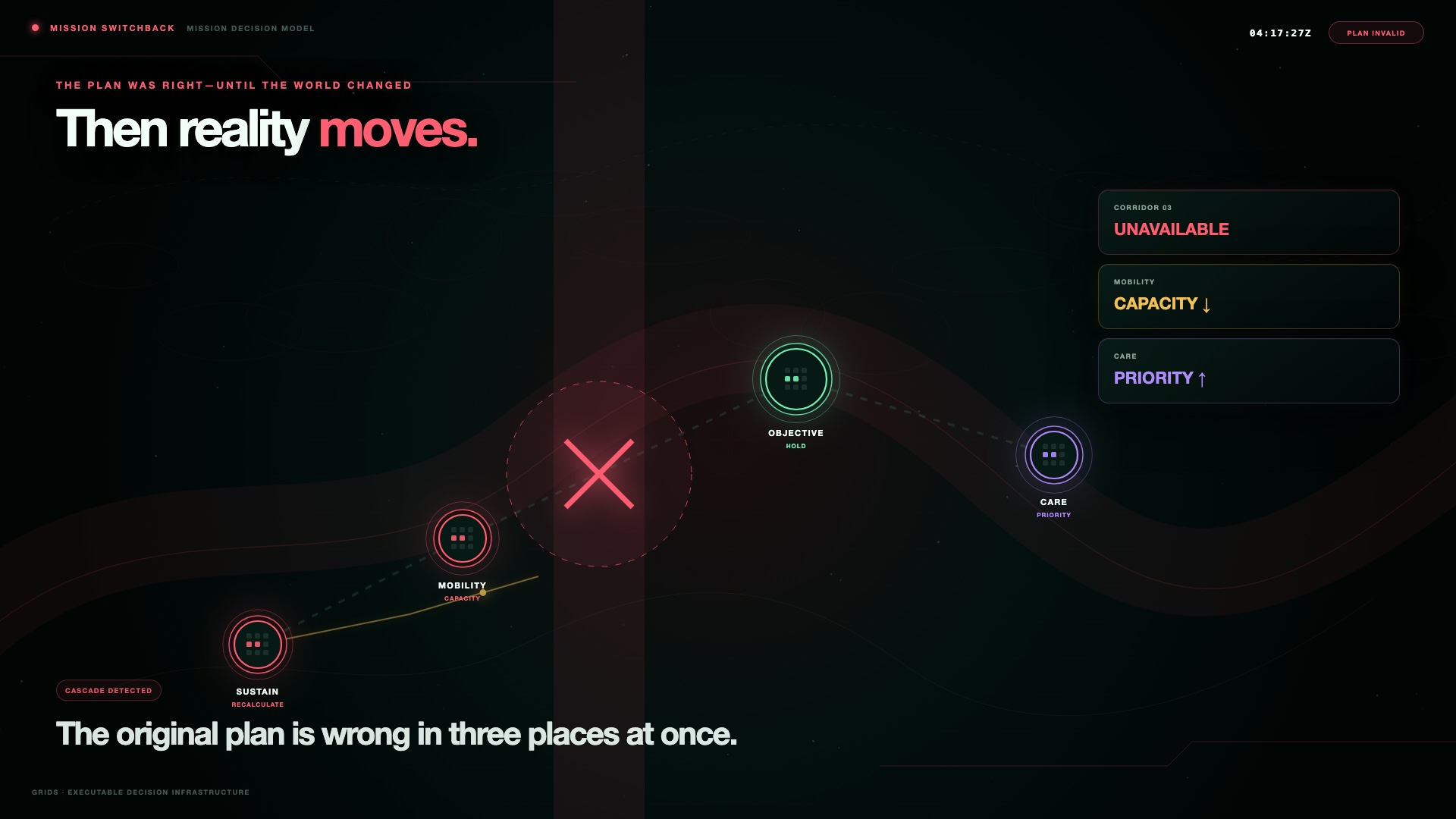 ▶ 1:12
Jump to a section in this publication
The logistics picture is not yet a supportable plan
A stock report can be accurate and a route display can be current while the combined sustainment plan is already infeasible. On-hand quantity may include protected reserve, inspection hold, or stock committed elsewhere. A route may be open but lack movement capacity, miss a delivery window, or depend on a handoff that has not been accepted. Demand may have changed after the last export. When those facts live in separate systems, the staff has to rebuild the conclusion by hand.
That is the use case: not another logistics dashboard, but an inspectable answer to a bounded question—can the represented sources deliver the required support, through permitted routes, within the mission window, under the applicable priorities and authority? When a route or stock fact changes, the answer should change with it. The earlier plan should remain reconstructable, and a proposed replan should stop before action that only an authorized person or external system can take.
The public record establishes why this is a real institutional problem. 10 U.S.C. § 2926 defines a contested logistics environment, for that operational-energy section, as one in which an adversary challenges logistics across domains and directly targets logistics operations, facilities, and activities. The statute also addresses assessment of energy supportability and planning measures such as distributed storage and improved automation. It does not prescribe a software product or transfer command authority.
The Joint Staff identifies JP 4-0, Joint Logistics as the keystone publication for logistics planning, execution, and assessment. The Joint Staff also states that doctrine is official advice while the commander's judgment remains paramount. The Army's March 2026 FM 4-0, Sustainment Operations describes distribution management as synchronizing transportation, distribution networks, and materiel with supported priorities. It emphasizes time available versus time to execute, continuous assessment, logistics-status reporting, and operations in which routes, infrastructure, communications, and partners may be unavailable or contested.
Those sources establish the planning environment. They do not establish that Grid conforms to doctrine, is suitable for an operational network, or improves a mission outcome. The architecture below is a proposition to test.
The current workflow fractures one conclusion across several owners
In a typical planning cycle, inventory resides in a supply or enterprise-resource system; route condition and movement capacity sit with movement control; demand comes from an operational plan; maintenance, quality, medical, contracting, or partner records add constraints; and the decision appears in a spreadsheet, message, map, or briefing product. Each product may serve its purpose. The failure occurs when each also becomes an independent implementation of availability.
The staff then spends its time discovering whether a quantity means on hand or releasable, whether a route status applies now or at departure, whether two lifts draw from the same capacity, and whether a suggested allocation respects current priorities. A fast replan that double-counts stock is not decision advantage. Neither is a synchronized display that hides stale evidence.
A bounded model needs explicit input contracts:
| Input | Minimum meaning required for evaluation | Authority remains with |
|---|---|---|
| Demand | Item or capability, quantity, destination, required interval, priority, accepted revision | Supported command and designated planning process |
| Stock | Identity, location, unit, on-hand quantity, reserve, holds, commitments, observation time, source | Supply, maintenance, quality, or other accountable source owner |
| Movement | Origin, destination, mode, capacity, route status, departure and arrival windows, restrictions | Movement control and the systems or partners that own the source fact |
| Rules | Substitution, reserve, allocation, timing, risk, and approval constraints with effective version | Authorized policy, command, and functional owners |
| Decision | Selected alternative, deviations, accountable actor, authority evidence, time, downstream acknowledgments | The person or external process empowered to act |
Unknown is not zero. Reported is not releasable. Feasible is not authorized. A model that keeps those states separate is more useful than one that forces every record into green or red.
A reproducible synthetic exercise
The following arithmetic is a synthetic training fixture. It represents no unit, operation, location, system, threat, or customer. The bundle is an abstract unit, the routes are lettered alternatives, and hours are measured only from the exercise start. The numbers exist solely so another reviewer can reproduce every conclusion.
The modeled requirement is 60 identical support bundles delivered by exercise hour 10. Substitution and partial bundles are not allowed. Source 1 reports 42 bundles on hand, but 10 are protected reserve, leaving 42 - 10 = 32 releasable. Source 2 initially reports 40 on hand with four on hold, leaving 40 - 4 = 36 releasable. Initial total releasable stock is therefore 32 + 36 = 68.
The baseline plan sends 30 bundles from Source 1 on Route A and 30 from Source 2 on Route B. Both movements arrive by hour 10, and each remains within route capacity. The plan delivers 60 bundles with eight releasable bundles unallocated.
Two accepted facts then change at exercise hour 2:
- Movement control reports Route A unavailable for the remainder of the exercise.
- The accountable stock source places eight additional Source 2 bundles on hold. Source 2 releasable stock falls from 36 to
40 - 4 - 8 = 28.
The represented movement alternatives are deliberately small enough to inspect:
| Route | Source | Maximum bundles | Transit time | Latest departure for hour-10 arrival | Changed state |
|---|---|---|---|---|---|
| A | Source 1 | 32 | 4 hours | Hour 6 | Unavailable |
| B | Source 2 | 36 | 5 hours | Hour 5 | Available, but only 28 bundles are releasable |
| C | Source 1 | 24 | 7 hours | Hour 3 | Available |
| D | Source 1 | 16 | 6 hours | Hour 4 | Available; separate movement authorization required |
Using only Routes B and C delivers 28 + 24 = 52, an eight-bundle shortfall. Simply adding Source 1's remaining eight releasable bundles would reach 60 on a stock report, but there is no represented path for them; putting 32 on Route C would exceed its 24-bundle capacity. The bounded feasible proposal is:
| Movement | Bundles | Stock check | Route check | Arrival check |
|---|---|---|---|---|
| Source 2 via B | 28 | Uses all 28 releasable | At or below capacity 36 | Departs by hour 5 |
| Source 1 via C | 24 | Part of Source 1's 32 releasable | At capacity 24 | Departs by hour 3 |
| Source 1 via D | 8 | Source 1 total is 24 + 8 = 32 |
At or below capacity 16 | Departs by hour 4 |
| Total | 60 | No stock or reserve double-counted | All represented route limits pass | All represented arrivals meet hour 10 |
The result is represented feasible, pending the required movement and command decisions. It is not an order. It is not proof that Routes B, C, or D are safe, available, accredited, or tactically appropriate beyond the fixture. The model has evaluated only the declared alternatives. A qualified planner may introduce another valid alternative, and the authorized decision maker may reject this one for a consideration that the fixture does not represent.
The explanation should show more than “feasible.” It should identify Route A's removal, Source 2's eight-bundle hold, the rejected protected-reserve option, the binding 32-bundle Source 1 stock limit, Route C's capacity, Route D's approval gate, and the departure deadlines. If the Route C decision is not made by hour 3, the same proposal becomes infeasible even though no stock quantity changed.
The Grid operating pattern
Grid can represent the exercise as a dependency graph rather than a collection of copied outputs. Configured connectors or controlled imports bind source records to typed quantities, units, locations, observation times, and validity intervals. The model derives releasable stock, eligible movement capacity, arrival feasibility, and demand coverage. A changed source invalidates only the dependent conclusions. A prior state is available for comparison or replay only when the relevant source, model, history, fixtures, and runtime identity were committed and retained.
Role-specific surfaces can then use the same model without becoming the same screen. Supply personnel inspect holds and reserve. Movement control sees route and capacity dependencies. Planners compare represented alternatives. Command receives a concise finding with reasons and unresolved gates. An evaluator can replay the exact source and model revisions. A downstream execution system receives an instruction only after its own authenticated authority and interface conditions are satisfied.
This pattern does not make every source globally visible. The DoD Data Strategy calls for data to be visible, accessible, understandable, linked, trustworthy, interoperable, and secure; those goals must be balanced together. A permitted model result may cross a boundary while protected source detail remains local. Coalition Computation Across Sovereign Boundaries examines that narrower federation problem.
Roles, controls, and the point where software stops
The source owner attests to stock or route status. The model owner governs definitions, formulas, test cases, and effective versions. The planner composes alternatives and records assumptions. Movement control validates capacity and routing within its authority. The command or delegated decision authority selects, rejects, or modifies the plan. Execution systems and operators perform the authorized movement and return acknowledgments or exceptions.
Grid can calculate, reject, trace, compare, and explain. It cannot establish source truth, classify information, approve release, assign priority, waive reserve, issue an order, contract transport, direct a partner, or confer command authority. These stops must be implemented as permissions and external controls, not left as prose beneath a button.
Integration should preserve the systems of record. Every connector needs a field map, unit conversion, freshness rule, duplicate and correction behavior, error state, identity, and receipt. A partial update must not look complete. A message accepted by middleware is not evidence that the receiving system acted on it.
Security is part of the operating design. The DoD Zero Trust Strategy and Roadmap addresses identity, devices, applications, data, networks, automation, and visibility across the information enterprise. A Grid evaluation must inherit the actual environment's classification, releasability, need-to-know, purpose, retention, cryptographic, audit, and authorization requirements. This page claims no authorization to operate, cross-domain approval, classified suitability, or indefinite disconnected capability.
Failure modes worth testing first
- A stock feed is current but uses cases while the demand uses individual units.
- Two routes consume the same vehicle or handling capacity.
- A correction arrives after a planner exported the briefing.
- A stale route remains visually green because the source has gone silent.
- Missing stock becomes zero and triggers an unnecessary replan.
- Missing stock remains silently unchanged and supports a false feasible result.
- A protected reserve is consumed because an arithmetic optimizer sees available quantity.
- A route is feasible by travel time but misses a loading, security, or reception window.
- A role can approve an alternative outside its delegation.
- A disconnected node returns with an older source or model revision.
The expected response is not always a new plan. It may be unresolved, stale, conflicted, or authorization required. Refusal is a successful outcome when the evidence is insufficient.
Acceptance criteria for a bounded evaluation
Begin with an unclassified or otherwise appropriately controlled fixture, one support decision, a small route set, and designated authorities. Freeze the oracle before running the system.
| Test area | Minimum acceptance evidence |
|---|---|
| Arithmetic | Every stock, capacity, timing, and demand result matches independently calculated expected values |
| Change propagation | Route and stock revisions update every dependent conclusion and no unrelated conclusion |
| Explanation | A reviewer can reconstruct binding constraints, rejected alternatives, source times, and model version |
| Authority | Reserve release, route approval, plan selection, and downstream action fail closed without the required role evidence |
| Integration | Duplicates, corrections, timeouts, partial updates, retries, and acknowledgments remain explicit |
| Security | Approved reviewers confirm identity, access, marking, minimization, logging, retention, and environment boundaries |
| Operations | Baseline and modeled runs report elapsed time, handoffs, rekeys, and defects without turning differences into promised improvement |
Retain the source snapshots, mapping specification, model package, formulas, expected results, executed results, role matrix, authorization events, interface receipts, failures, and evaluator disposition. A passed fixture supports only the declared product-demonstration claim. It does not demonstrate operational readiness or mission advantage.
For deeper context, read From Supply Visibility to Executable Availability, Readiness Is a Graph, and Course-of-Action Feasibility. Use the decision evaluation worksheet to capture the current workflow and acceptance oracle before implementation.
The useful outcome is not a more persuasive logistics picture. It is a plan whose demand, stock, routes, time, rules, evidence, and authority remain connected closely enough that a changed fact produces an inspectable decision—not another round of copy reconciliation.
Related films, scenarios, and next steps
Continue exploring
Follow the next question.
Course-of-Action Feasibility Without the Slide-Deck Reconciliation Cycle
A course of action remains feasible only while its facts, assumptions, resources, timing, constraints, and authority remain aligned. This paper separates the public planning record from a bounded Grid proposition for keeping that conclusion inspectable as conditions change.
Understand · PlanSource-grounded ExploreHow Grid Works: From Typed Facts to Accountable Action
A technical and operational guide to the six-stage Grid chain: governed sources, a shared and versioned model, reactive constraint evaluation, coordinated surfaces, explanation and evidence, and AI assistance bounded by human authority.
Understand · EvaluateSource-grounded ExploreFrom Common Operating Picture to Common Operating Model
Seeing the same facts is not the same as calculating from the same rules. A common operating model connects source identity, dependencies, constraints, alternatives, authority, role-specific views, and replayable evidence.
Understand · EvaluateSource-grounded Explore