White paper · Joint planning
Course-of-Action Feasibility Without the Slide-Deck Reconciliation Cycle
A course of action remains feasible only while its facts, assumptions, resources, timing, constraints, and authority remain aligned. This paper separates the public planning record from a bounded Grid proposition for keeping that conclusion inspectable as conditions change.
Narrated film · 1:12
One transport disappears. Three planning views disagree.
Watch the shared model expose what changed, compare the remaining options, and leave the revised plan for an officer to approve.
An authored scenario that explains the idea. Read the story and its limits.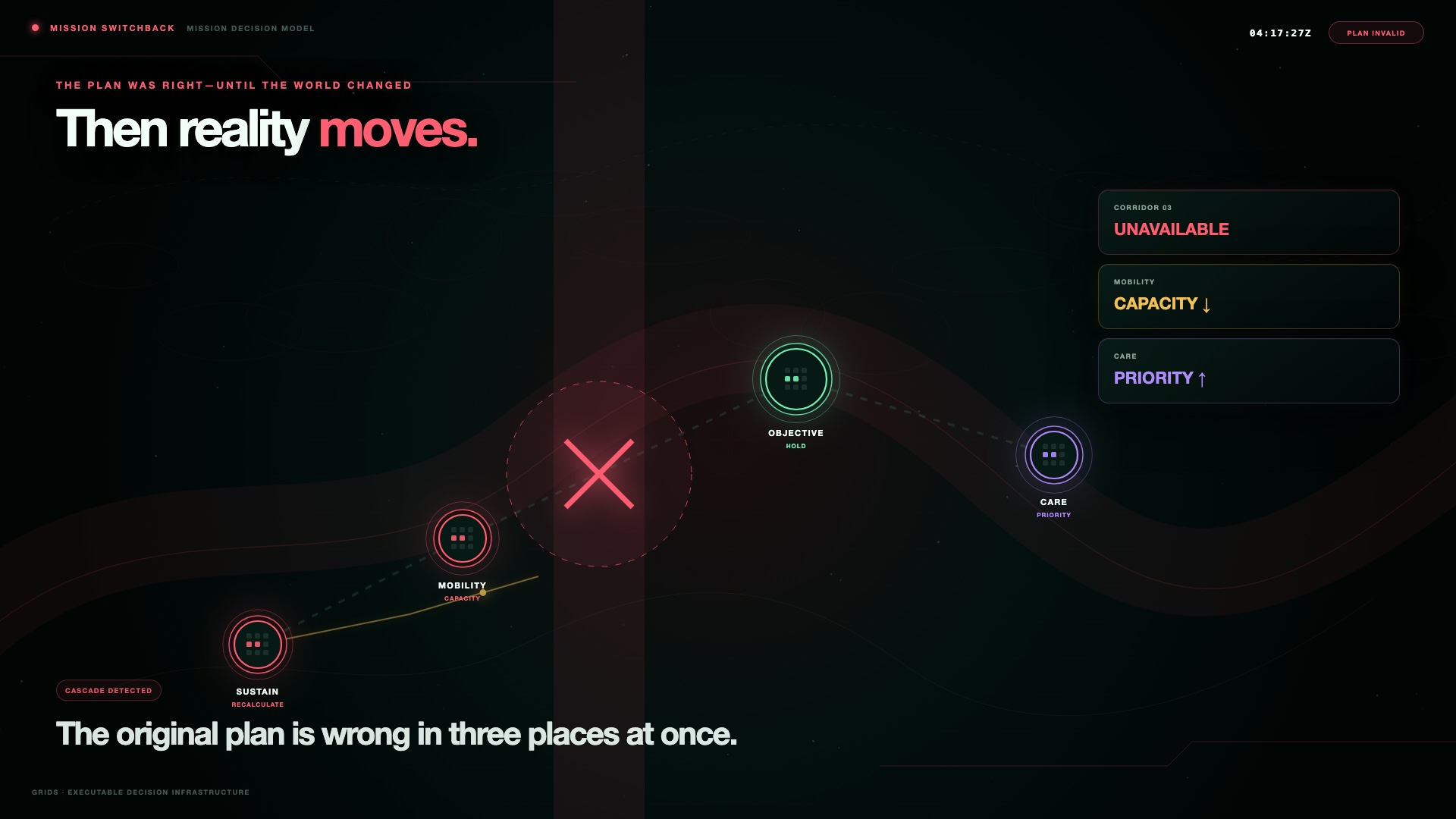 ▶ 1:12
Feasibility trace
Feasibility is a trace, not a color.
A course of action remains answerable only when the team can move from the current observation through assumptions, constraints, alternatives, and review to the exact decision that was authorized.
- Source authorityObservation
Identify the source revision, observed time, freshness, and confidence of the changed fact.
- Planning staffAssumptions
Separate accepted facts from planning assumptions and state what would disprove each one.
- Governed modelConstraints
Represent time, capacity, sequence, supportability, policy, and authority limits explicitly.
- Cross-functional staffAuthored COAs
Evaluate only the alternatives and branches the team deliberately placed inside the fixture.
- Governed modelFeasibility finding
Return feasible, infeasible, conditional, or unresolved with binding reasons and omissions.
- Commander and effect ownerDecision and effect
Keep recommendation, command decision, tasking, external execution, and acknowledgment distinct.
Jump to a section in this paper
Feasibility lives below the briefing
A course of action can look coherent on a slide while the facts beneath it have already separated.
Operations still shows six available transports. Logistics has accepted a revision that reduces the number to five. The movement table was exported before the change. The command summary still carries the earlier completion time. Each product is internally understandable; together, they no longer describe one feasible plan.
The resulting reconciliation cycle is familiar: identify which copy is current, ask each staff section to recompute its part, paste revised numbers into briefing products, resolve disagreements, and return the package for review. The problem is not the slide format itself. Slides are useful for communication. The problem is allowing the briefing artifacts to become independent implementations of the decision.
Feasibility is not a color assigned during a meeting. It is a conclusion produced from mission purpose, facts, assumptions, time, space, resources, dependencies, risk, and the constraints represented by the staff. When any material input changes, the conclusion may change with it.
The institutional record establishes that planning is iterative, that sustainment must inform operations, that valid alternatives must meet defined criteria, and that disconnected information flows impede command and control. Grid enters this paper separately as a proposition: represent a bounded course-of-action decision as a shared executable model, then test whether that model helps staff sections maintain one inspectable feasibility conclusion as declared facts change.
What the public record establishes
The Joint Staff identifies JP 5-0, Joint Planning as the keystone publication for planning joint campaigns and operations. The same official page states an essential authority boundary: joint doctrine is official advice, while the commander's judgment remains paramount. A computational finding can inform that judgment; it does not inherit it.
Course-of-action analysis is also more than choosing among attractive concepts. A Joint Staff focus paper on combatant-command command-and-control organizational options reproduces the JP 5-0 screening criteria: a course should be adequate, feasible within time, space, and resource limits, acceptable in its balance of cost and risk against advantage, distinguishable from other courses, and complete. Those criteria require evidence from several staff functions. No operations concept can establish its own logistical feasibility merely by asserting it.
The integration challenge is explicit in the Joint Staff's Sustainment: Insights and Best Practices. Sustainment responsibilities may be distributed across several directorates and special staffs, each contributing a distinct view. The paper says synchronization is necessary to inform the commander's decision cycle, and it calls for sustainment representation, staff estimates, and supportability analysis throughout planning and execution. This is an organizational requirement, not a software endorsement.
An Army sustainment practitioner described a narrower observed failure mode after exercise and classroom planning repetitions: sustainment planners often struggled to develop multiple support courses for a single maneuver concept. His official Army article, “Developing multiple sustainment courses of action in support of a maneuver plan”, distinguishes among task organization, fixed and mobile assets, and other support choices that can give commanders meaningfully different options. This is practitioner observation, not a department-wide prevalence measure, but it shows why “logistics concurs” is not a substitute for authored support alternatives.
Planning state also moves. In the joint-air context, JP 3-30, Joint Air Operations, directs staffs to revisit and update estimates during planning, execution, and assessment. It distinguishes facts from assumptions, requires assumptions to be reviewed for validity, and notes that a disproved assumption may produce a new fact or a new assumption. The important pattern extends beyond air planning: a plan must retain the basis of its conclusions well enough to identify what a changed condition invalidates.
Finally, the information problem is not hypothetical. In GAO-25-106454, GAO described the Department of Defense's intended movement from manual “swivel chair” entry across systems toward integrated data for command and control. GAO also found military-department projects proceeding largely in isolation, limited sharing of experimentation lessons, and no comprehensive framework for guiding investments and measuring progress. The report concerns CJADC2 governance and data sharing, not course-of-action software. It supports a narrower conclusion here: moving and reconciling information across independent implementations is a documented obstacle, and measurement matters.
Contested conditions make provenance and freshness more important, not less. The Army's March 2026 FM 4-0, Sustainment Operations discusses operations in which routes, infrastructure, communications, and partners may be unavailable or contested, while logistics status and running estimates continue to inform decisions. Coalition exchange adds another boundary: NATO's 2025 Data Strategy for the Alliance describes shared data spaces and federated data meshes while Allies retain control of their data. Neither source implies that the newest timestamp automatically wins, that disconnection expands authority, or that every partner may receive every source detail.
These sources establish doctrine, observations, and institutional demand. They do not establish that Grid satisfies JP 5-0, JP 3-30, CJADC2, or any program requirement. They do not prove that an executable model will improve planning in a particular headquarters. That proposition must be evaluated with declared fixtures, users, constraints, and acceptance criteria.
The Grid proposition: one governed feasibility object
Grid proposes that a planning team represent one bounded course-of-action decision as a reactive computational model instead of reconstructing its logic separately in an operations worksheet, logistics workbook, synchronization matrix, command deck, and application.
The object should carry at least seven kinds of state:
- Named facts and assumptions: source identity, revision, observed or effective time, freshness, uncertainty, and whether the value is accepted, disputed, missing, or assumed.
- Dependencies: which activities, resources, timings, effects, and views depend on each fact.
- Constraints: declared limits for capacity, timing, sequence, eligibility, supportability, policy, and authority.
- Authored alternatives: the specific courses and branches the team chose to represent, including their assumptions and required external actions.
- Evaluation state: feasible, infeasible, conditional, or unresolved, with the binding constraints and model revision attached.
- Explanation: why each represented alternative received its status, what changed, and which evidence would change the conclusion.
- Authority and coordination: who may decide, what evidence records that decision, and which role-specific views resolve from the accepted revision.
This is not a claim that all operational judgment can be reduced to formulas. It is a claim that the computable parts of a bounded feasibility assessment should not be hidden in several private copies. Qualitative judgment, adversary interpretation, political context, commander guidance, legal advice, and unmodeled risk remain visible inputs or external responsibilities rather than invented precision.
Course Echo: a deliberately small example
Consider the fictional Course Echo fixture used in Every System Works. The System Does Not. and the changed-fact journey.
Course Echo requires six movements beginning at 08:00Z. Each movement wave takes 40 minutes, and the window closes at 08:45Z. With six available transports, the represented schedule uses one wave, completes at 08:40Z, and carries five minutes of modeled margin.
At 07:12:18Z, the fictional Logistics Capacity Model advances from revision L-441 to L-442 and reduces available transport from six to five. The operations view and command summary still show the previous feasible state. Under the authored calculation, five transports require two waves. Completion moves to 09:20Z, 35 minutes outside the represented window.
The model then evaluates two predefined branches. Branch A waits 15 minutes while retaining five transports; it remains infeasible. Branch B restores six available transports by requesting external reallocation of TRANSPORT-ECHO-06; it is conditionally feasible, because the schedule returns to 08:40Z only if the responsible external authority approves and records that reallocation.
| Course Echo state | Available transports | Waves | Modeled completion | Finding | What the finding does not prove |
|---|---|---|---|---|---|
Baseline L-441 |
6 | 1 | 08:40Z | Feasible with 5 minutes of modeled margin | The movement is not ordered or completed |
Changed fact L-442 |
5 | 2 | 09:20Z | Infeasible; 35 minutes beyond the window | The source is not validated merely because it is newer |
| Branch A: wait 15 minutes | 5 | 2 | 09:35Z | Infeasible | Waiting does not restore capacity |
| Branch B: request reallocation | 6 if approved | 1 | 08:40Z if approved | Conditional | Recommendation is not reallocation authority |
The model has not discovered the best military course. It has evaluated exactly two authored alternatives against a deterministic scheduling fixture. It has not modeled adversary action, route risk, crew status, maintenance, fuel, protection, diplomatic clearance, competing demand, or the many other considerations a real headquarters may require. Branch B is a recommendation, not an executed movement. Grid cannot allocate the transport or create the authority to do so.
What the fixture demonstrates is narrower: a named change can invalidate a modeled conclusion, expose stale views, attach reasons to represented alternatives, and stop at an explicit authority boundary. Decision Advantage presents the broader model-to-explanation pattern; Contested Logistics applies it to a route change.
Explanation and coordinated views are part of feasibility
A status without a reason invites another reconciliation meeting. A useful review packet should identify the source revision, affected dependency path, model revision, declared constraints, alternatives evaluated, binding reasons, assumptions, unresolved evidence, and external actions each branch requires.
Different roles should not be forced into one display. J3 may need activity timing and branch consequences. J4 may need resource provenance, capacity, and supportability. J5 may need assumptions, risk, and consistency with the broader plan. A commander may need a concise comparison and explicit decision points. A configured API may need a small versioned result. Coordinated views means those surfaces resolve from the same accepted modeled state; it does not mean they expose identical information or erase role, security, and releasability boundaries.
The authority record matters just as much. Authentication may show who acted, but the organization must determine whether that person held the applicable command or delegated authority for that decision. Until the external reallocation is authorized, Course Echo remains conditional. If required evidence or authority is absent, the model should preserve that absence rather than promote the branch to feasible.
Degraded and coalition operations require an event ledger
In a second fictional fixture, Exercise Northstar, one node disconnects after accepting source revision S-207. A partner later publishes S-208, but the isolated node cannot receive it. The local model may continue only within the explicitly authored offline window and labels every result as of S-207. It cannot claim to be current, expand its releasability, or use the loss of connectivity as emergency authority.
| Event | Local evidence state | Permitted represented state | Explicit stop |
|---|---|---|---|
| Connected acceptance | S-207 attributed, current under the fixture |
Feasibility may be evaluated against S-207 |
No operational action is implied |
| Link loss | No later source can be observed | Prior result becomes time-qualified | Disconnection does not enlarge permission or authority |
| Local branch authored | Branch binds to S-207 and declared assumptions |
Draft and evaluate locally | Not releasable or authorized by default |
| Reconnection | S-208 arrives with a conflicting capacity fact |
Preserve both revisions and invalidate affected results | Latest timestamp alone does not resolve source authority |
| Reconciliation | Qualified source owner accepts the applicable revision | Recompute, review, and issue a successor state | Prior submission and real-world effect remain separate facts |
A model status must also distinguish feasible, releasable, authorized, submitted, acknowledged, and independently confirmed effect. Those states may be related, but none is a synonym for the next. Coalition Computation Across Sovereign Boundaries examines how a permitted result can travel while protected source detail and national authority remain local.
Limits that remain outside the model
An executable feasibility model is only as complete as its sources, bindings, rules, alternatives, and tests. It cannot make stale data true, infer every missing constraint, predict adversary behavior, or guarantee that an authorized plan will succeed. A solver result over represented alternatives is not proof of global optimization or operational superiority.
Grid makes no claim here of deployment, operational outcome, CJADC2 compliance, authorization to operate, classified-environment suitability, cross-domain approval, or real-time performance. Local or distributed execution does not guarantee communications availability, immediate propagation, indefinite disconnected operation, or conflict-free recovery. Every integration, security control, data-handling rule, model revision, and effect boundary must be assessed in the intended environment by the responsible authorities.
A bounded evaluation with measurable acceptance criteria
Begin with one recurring planning decision, not an enterprise command-and-control transformation. Select a small course-of-action set, a declared resource and timing model, two or three participating staff functions, and one recognized decision authority. Preserve the current workflow as the baseline before configuring Grid.
Run both workflows through the same controlled events: a capacity reduction, a stale source, contradictory revisions, a shifted timing window, a resource claimed by two courses, a constraint omitted and then added, and a condition requiring authority the model does not possess. Retain the input fixtures, model and source revisions, evaluated alternatives, explanations, user actions, decisions, and view acknowledgments.
Measure at least five layers:
- Fact integrity: material inputs linked to source, time, and revision; stale or contradictory evidence detected; assumptions visibly distinguished from accepted facts.
- Feasibility behavior: represented courses assigned feasible, infeasible, conditional, or unresolved status; binding constraints identified; repeated fixtures producing the same governed result; seeded omissions discovered during review.
- Reconciliation effort: manual transfers and rekeys, conflicting statuses across staff products, elapsed time from accepted source change to a reviewed feasibility update, and time spent resolving revision differences.
- Explanation and comprehension: alternatives with inspectable reasons, planners able to identify what changed and why, reviewers able to identify missing constraints, and decision makers able to distinguish a recommendation from an authorized action.
- Authority and coordination: conditional courses prevented from becoming executed state without required evidence, decisions attributable to the correct role, role-specific views resolving from the accepted revision, and failed or delayed acknowledgments remaining visible.
Set thresholds before seeing the result. For example, require every material feasibility input to retain provenance, every rejected alternative to expose a binding reason, every seeded unauthorized action to remain blocked, and every participating view to identify its model revision. Treat timing as a measured evaluation result, never a real-time guarantee.
A successful controlled fixture can support a product-demonstration claim within those boundaries. Customer-controlled testing is required to establish behavior with actual systems, policies, staff practices, and security controls. Mission impact requires operational evidence beyond both.
The practical next step is to trace one planning revision through the contested-sustainment use case and From a Changed Fact to Coordinated Action, change the Course Echo capacity in the interactive lab, and use the decision evaluation worksheet to record the baseline, acceptance criteria, and authority boundary. Implementation teams can then inspect the Grid Developers guidance for explaining and validating a changing decision.
The objective is not to eliminate briefings. It is to ensure that when the briefing changes, the facts, constraints, alternatives, reasons, and authority behind it remain one inspectable decision.
Related films, scenarios, and next steps
Continue exploring
Follow the next question.
Replan Sustainment When Route and Stock Change
Connect usable stock, movement capacity, time windows, mission demand, and command authority so a changed route or inventory fact produces an inspectable replan rather than another reconciliation cycle.
Understand · PlanSource-grounded ExploreHow Grid Works: From Typed Facts to Accountable Action
A technical and operational guide to the six-stage Grid chain: governed sources, a shared and versioned model, reactive constraint evaluation, coordinated surfaces, explanation and evidence, and AI assistance bounded by human authority.
Understand · EvaluateSource-grounded ExploreThe Medical Plan Must Move
Dynamic Capacity, Evacuation, and Resupply PlanningA medical plan can become infeasible when demand, staffed capacity, transport, time, or materiel changes. This paper separates the public evidence for continuous planning from a bounded Grid proposition that stops at clinical and command authority.
Understand · PlanSource-grounded Explore