Scenario · Connected trading decisions
The Seven-Minute Balance Sheet
A package lead has seven minutes to keep one acquisition-financing package current while market data, internal pricing, risk, approvals, and execution retain separate owners.
- What this is
- A published decision scenario. Its setting and values are invented for illustration.
- What this shows
- How declared facts and rules produce a traceable result when conditions change.
- What this does not show
- A customer deployment, measured outcome, or transfer of authority to software.
Narrated film · 1:25
The Seven-Minute Balance Sheet
Watch changed terms flow through the calculations and review, so the people responsible can see what still holds before release.
 1:25
1:25
Story
Start with the event and the decision it creates.
The story
12:58 p.m. — seven minutes to synchronize the package
At 12:58 p.m., Morrow Health Administration's CFO asks Asterion Bank for one final acquisition-financing package by 1:05. Asterion's accountable package lead has seven minutes to keep the financing, hedge, capacity, risk, and approval views synchronized long enough to deliver terms that carry honest validity windows.
At 1:00, the Treasury auction moves the market while one upstream price feed freezes at its pre-auction observation. The package lead now has to exclude a reassuring but stale price, propagate the valid market change, preserve each desk's authority, and still meet the client deadline. A mixed-time package could look complete while no longer being executable as represented.
This is the final pricing call after six weeks of diligence, conditional credit approval, suitability review, documentation, model approval, limit checks, and provisional capacity work. No one is pretending to underwrite a multibillion-dollar client from scratch in seven minutes.
The represented package combines a bridge and backstop, a floating-rate term loan, a Treasury rate lock for a planned bond takeout, and a deal-contingent equity collar. The lock and collar must be executable for ninety seconds, while the financing commitments retain their negotiated conditions and clocks. The “balance sheet” in the title is the bank capacity and contingent liquidity that must remain aligned with those pieces, not an accounting statement produced in seven minutes.
Morrow does not want four disconnected indications. It wants one synchronized commercial package, with relevant capacity held and the market-risk legs capable of being hedged. In a conventional workflow, each desk waits for another desk's refreshed spreadsheet and Risk later reconciles snapshots taken at different times. Asterion instead connects the decisions while preserving their separate owners.
1:00 p.m. — a market move and a frozen source
The authored auction tails its when-issued level by 2.3 basis points. Futures fall, secured-financing indications widen, and implied volatility rises. The frozen source still sends heartbeats, but its sequence and observation time stop advancing.
Asterion's authored data-quality rules test age, sequence, cross-feed residuals, and curve consistency. The frozen source breaches the bank's 750-millisecond auction-window freshness rule and its 1.5-basis-point residual rule. Those thresholds belong to this authored bank configuration; they are not market standards built into Grid.
The desk-side model excludes the stale source, rebuilds the affected Treasury curve with Asterion's approved pricer, and applies a separately validated model to one quote-width component. The proprietary model does not invent fair value or set the bank's funding curve. The trader and package lead see the updated quote and refusal logic together: which source was rejected, which curve changed, and which charges widened the spread.
Grid can hold the dependency graph, predicates, exact model and extension identities, and incremental recomputation. Asterion must supply and validate the market feeds, security master, pricing logic, policies, and limits.
1:00:20 p.m. — owned facts cross bounded contracts
The government desk, Rates curve authority, Secured Funding, and Group Treasury publish only the values the package was designed to consume, each with its revision, observation time, validity, and model or convention identity. Restricted desk data stays inside its controlled environment under bank-managed identity, entitlement, logging, and administration. Locality by itself is not a privacy or security guarantee.
Fast-changing prices may use the latest accepted value. Fixing candidates, approvals, quote transitions, orders, and fills remain ordered because every transition matters. A flashing market screen and an audit sequence are not the same record.
At 1:01, Group Treasury receives the auction and repo evidence and declines to become a trading desk. Its approved morning transfer-pricing curve remains at revision 1842. The new facts trigger a deal-only funding review, not a tick-for-tick rewrite of bank policy. The proposed overlay is +6 basis points, annualized on stressed bridge utilization, valid only for this package until 1:15. It sits inside an authored 0–8 basis-point band approved for this scenario.
The important distinction is visible: the external market reference changed, the bank-wide funding baseline did not, and one scoped contingent-liquidity proposal now awaits human approval. A Treasury officer and an independent Liquidity Risk reviewer must authorize that instance. Anything outside the approved band fails closed and escalates beyond the deal deadline.
1:01:30 p.m. — one change, different consequences
The same connected state reaches each desk's authoritative model home, and each receives a different consequence.
Credit keeps the term loan's contractual benchmark and borrower spread separate from internal funding. The bridge consumes the temporary liquidity overlay because the bank must be prepared for full draw under a stressed takeout. Debt Capital Markets sees the cash benchmark and Treasury lock move by different amounts because forward start, repo carry, discounting, and contract conventions remain distinct. The lock covers the benchmark component, not issuer spread or underwriting economics.
Equity Derivatives receives rates alongside its own dividends, stock borrow, volatility, correlation, and deal-break assumptions; the explanation does not blame rates for every change. Enterprise Risk receives the changed market and funding values under explicit contracts, while the bank's validated capital, margin, counterparty, legal-entity, and netting calculations remain in approved systems until equivalent capabilities are built and qualified.
The models can propose a hedge under declared lot, liquidity, inventory, position, and counterparty constraints. The external order and execution systems still check, execute, acknowledge, and book it. A model calculation does not become a trade.
1:02:40 p.m. — one package, several clocks
The internal package is not a collage of four screens. Before it can become releasable, Asterion's authored assembler pins an exact vector across Treasury, discount, repo, funding, product, risk, and capacity state. It verifies common snapshots where required and checks that the validity intervals overlap the release instant. A mixed or expired vector fails closed.
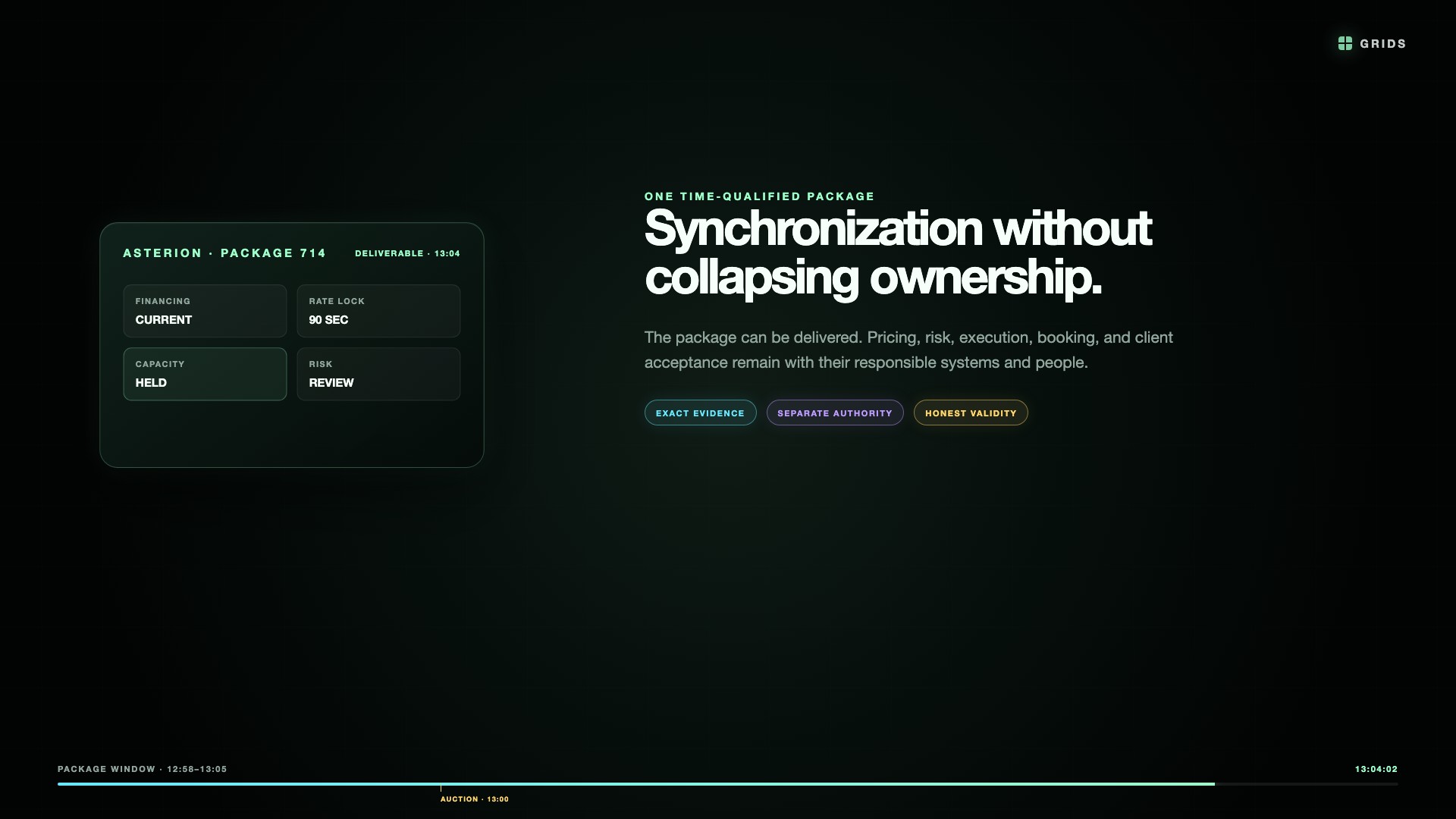
The bridge carries the pending six-basis-point overlay. The term loan's projected economics refresh while its benchmark definition and term funding baseline remain unchanged. The Treasury lock and collar become executable for ninety seconds. An external capacity service supplies a scoped hold with an expiry. At 1:03, the Treasury officer and independent Liquidity Risk reviewer approve the exact deal-only overlay. The capacity system converts the provisional hold and returns its own receipt. Grid records that evidence; it is not the concurrency-safe facility ledger.
At 1:04, Asterion delivers allowlisted commercial terms through an approved bank channel. The client document contains product conditions and the correct validity clock for each instrument. Source identities, model internals, approvals, and limit details remain in the internal evidence record.
Asterion does not predict the market perfectly. The package lead delivers the represented package before the deadline because all relevant owners can see which source froze, which values moved, which did not, why each desk's economics changed, which charge required authority, which capacity was held, and when every component expires. Delivery is not client acceptance, execution, or a transaction outcome.
The next morning — replay, not mythology
The next-day review distinguishes the package from the evidence of what later happened. Captured orders, cancels, partial fills, fees, and slippage can be replayed in strict sequence for a bounded reconstruction. That does not make Grid the bank's order manager, books-and-records archive, settlement platform, or regulatory reporter.
Asterion's evidence assembler joins the licensed-feed receipts, market and reference revisions, exact pricer and model identities, model-local explanations, workflow attestations, external capacity-hold token, and authoritative order, booking, and reporting records. An acknowledgment from an execution system proves receipt, not execution. A booking identifier or authoritative execution report establishes a different state. Later observations remain different again.
The seven-minute achievement is therefore not speed without governance. It is synchronization without collapsing ownership: one commercial package, several clocks, exact evidence, and separate authority all the way to the boundary of the systems that can actually trade and book.
Where the model stops
Grid can represent the evidence, calculation, alternatives, explanations, and proposed package. Bank-owned controls retain identity, entitlements, model validation, pricing authority, risk approval, booking, execution, reporting, and recordkeeping. A two-person approval applies to an exact revision; a receiving-system acknowledgment establishes receipt only.
What remains to prove
A controlled evaluation would require bank-owned adapters and controls, independently reviewed models, security and privacy assessment, negative-case testing, authoritative execution and outcome evidence, operational resilience, and regulated records. The Scenario is an illustrative design for evaluation, not a description of a production bank system.
Decision path
Follow the changed fact step by step.
A calculation, proposal, approval, execution report, and outcome are different events. The order keeps those boundaries visible.
- 01 · 12:58
Seven minutes to synchronize the package
Several desks must align one financing view before its represented validity window closes.
- 02 · 13:00
The auction breaks the shared assumption
A named market revision changes the package while one participating feed stops advancing.
- 03 · 13:00
The stale feed is rejected
Freshness and source rules keep an apparently valid number from entering the active package.
- 04 · 13:00:20
Owner-scoped contracts enter the fabric
Each desk contributes a bounded value without surrendering its source or decision responsibility.
- 06 · 13:01:30
Each desk receives a different consequence
Shared model state produces role-specific views without claiming identical permissions or interfaces.
- 07 · 13:03
Two-person control approves a deal-only overlay
Named approvers review the exact proposal and its evidence before any external instruction is eligible.
- 08 · 13:04 and next morning
A time-qualified package and replay close the loop
The package expires as declared, and retained inputs support a bounded review of what the model represented.
Evidence and limits
What the scenario represents—and what real-world use still requires.
Represented in this scenario
- Owner-scoped, time-qualified facts and internal model revisions
- Reactive dependencies, constraints, alternatives, and role-specific views
- An exact proposed package with review and authority evidence
Required integration and operating work
- Bank-owned market, risk, treasury, identity, entitlement, retention, and external-system integrations
- Independent model validation, security assessment, failure testing, and regulated operating controls
Decisions that remain with people and institutions
- Trading or booking
- Internal funding, risk-limit, or client-pricing decisions
- Release of a transaction or movement of funds
Evidence, authority, and publication recordView the scenario contract, capability record, authority stages, verification status, and related work.
Scenario contract
The setting, trigger, decision, and authority boundary.
- Setting
- An invented investment bank synchronizing an acquisition-financing package during a Treasury auction.
- Timeframe
- Seven minutes and the next-morning replay
- Trigger
- The auction moves the market while one source feed freezes.
- Decision
- Can the bank produce one time-qualified commercial package while preserving desk, Treasury, risk, and approval authority?
- Authority
- Grid may calculate and assemble evidence; market-data owners, Group Treasury, desk controls, risk, and external execution systems retain their actual authority.
One package, separate authorities
Shared state does not mean shared decision rights.
A named revision can move through calculation and review while each source, model, and action remains attributable.
- SourcesTime-qualified owned inputs
Market, Treasury, desk, and risk values retain source, revision, freshness, and permitted use.
- ModelConnected commercial package
Declared dependencies update affected terms and preserve stale or unresolved states.
- AlternativesExplained bounded choices
Retained, rejected, and conditional terms remain visible to reviewers.
- Human authorityDesk and dual-control review
Named institutional roles approve only the exact represented package within their authority.
- External evidenceSubmission, execution, observation
Receipt, authoritative execution reporting, and later records are distinct evidence events.
What is established
What is documented, what this scenario combines, and what still needs testing.
This separates documented capabilities from authored combinations in the scenario. Neither proves a complete deployment or outcome.
Documented building blocks
Capabilities described in maintained Grid documentation or another named source.
- Reviewed product primitives document typed source values, reactive delivery, compact risk, finance helpers, temporal explanation, and deterministic replay; this is not bank qualification or deployment evidence.
- Reviewed product primitives document exact signed packages, generic governed workflows, and model-bound surfaces; they do not establish a dealer platform.
Combined in this scenario
Capability combinations represented in this scenario that still require end-to-end evaluation.
- The authored design composes time-qualified market, Treasury, desk, and risk values into an explained package with an exact dual-control proposal.
- Bank-owned market adapters, pricing and risk models, entitlements, retention, and external transaction controls would connect the package to regulated systems.
Not yet proved
Integration, operating, policy, or evidence work that is not complete.
- A licensed Treasury market stack, OMS or EMS, bank-qualified pricing and risk libraries, and cross-host proof assembly remain missing.
- An executable fixture, bank security and model-risk qualification, high-availability controls, and authoritative execution evidence remain outstanding.
Proof and limits
What this scenario supports—and what remains to validate.
These states describe the scenario source and its defined checks. Real-world validation requires separate evidence.
- Scenario publication
- PublishedReleased August 27, 2026 as an operating scenario.
- Source readiness
- R2 · Sources reviewedDomain support and product capability boundaries have been reviewed.
- Scenario check
- Checks not runScenario revision 2026-08-27.1 defines the steps and expected results; the checks have not run yet.
- Independent review
- PendingThe expected results have not received independent review.
- Deployment evidence
- NoneNo customer deployment, production performance, or real-world outcome is claimed.
- Next proof required
- Advance beyond R2Run the defined checks, retain the results, and have an independent reviewer check the expected results.
Evidence and stewardship
What supports this scenario—and when it must be reviewed again.
Illustrative evidence
Authored operating scenario grounded by public reference-rate and model-governance sources; it is not trading advice, a bank deployment, or evidence of execution performance.
Invented elements. The bank, transaction, prices, timings, calculations, approvals, and outcomes are authored. Public sources ground only reference-rate and model-governance context.
- Owner
- Grid FYI Editorial
- Reviewed
- August 27, 2026
- Review due
- February 27, 2027
- Source revision
- 2026-08-26.3
- Scenario package
- investment-bank-seven-minute-balance-sheet
Related work
Related reading and examples.
These links are chosen as direct companions to this scenario.