Scenario · Planning under change
Course Echo: One Transport Disappears
A logistics update cuts available transports from six to five. One wave becomes two, the plan misses its window, and the only conditionally feasible repair still requires an authorized human decision.
- What this is
- A published decision scenario. Its setting and values are invented for illustration.
- What this shows
- How declared facts and rules produce a traceable result when conditions change.
- What this does not show
- A customer deployment, measured outcome, or transfer of authority to software.
Narrated film · 1:12
Every System Works. The System Does Not.
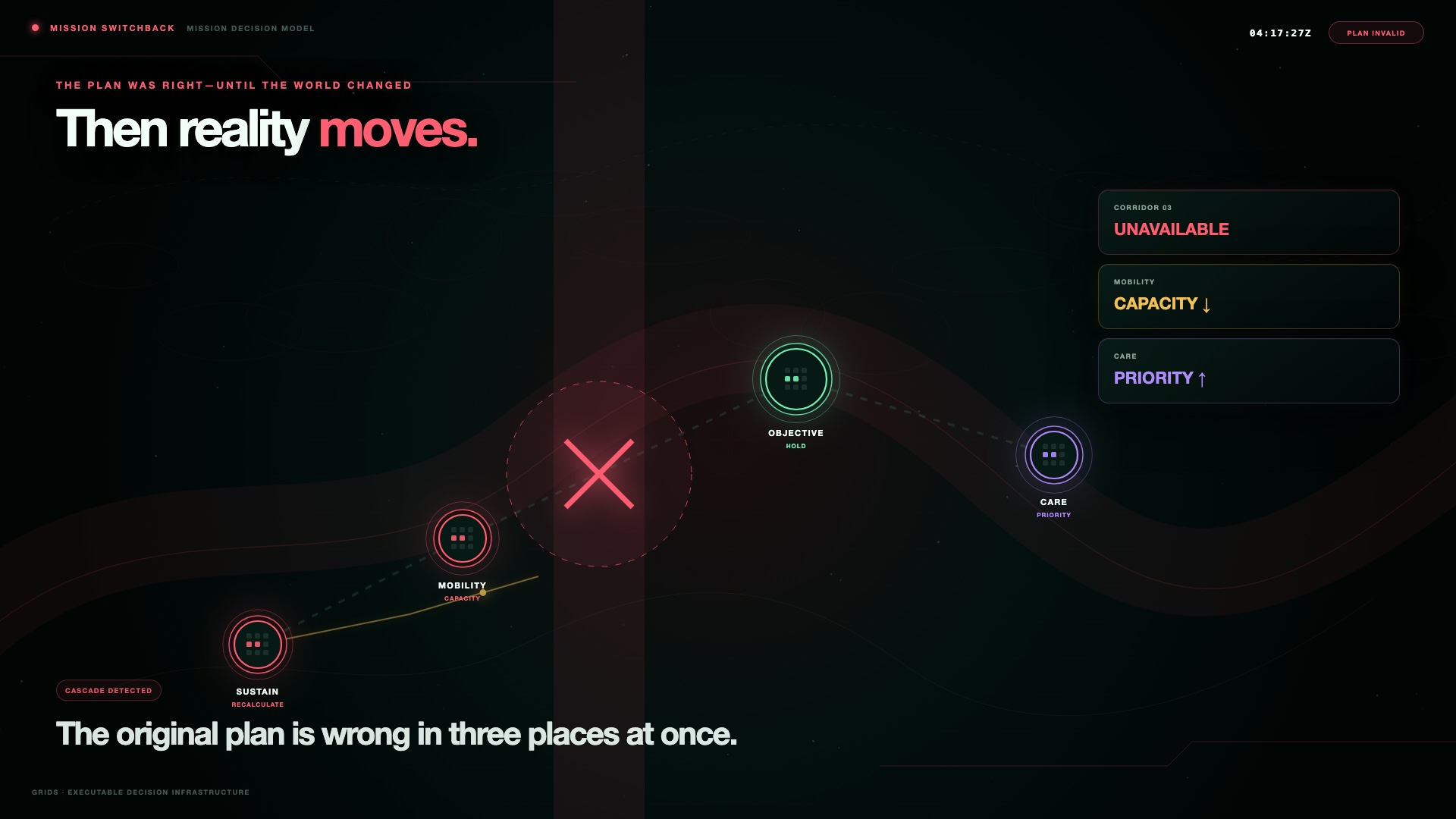
Watch the shared model expose what changed, compare the remaining options, and leave the revised plan for an officer to approve.
 1:12
1:12
Story
Start with the event and the decision it creates.
The story
07:12 — one green plan
At 07:12, the operations team believes Course Echo is ready. Six movements must begin at 08:00Z and finish before the 08:45Z window closes. Operations revision O-118, logistics revision L-441, and command summary C-203 all agree: six transports can carry the six movements in one forty-minute wave, finishing at 08:40Z with five minutes to spare.
Eighteen seconds later, the Logistics Capacity Model publishes revision L-442. Only five transports are now available. That one-unit change turns one wave into two: the modeled completion moves to 09:20Z, and a five-minute margin becomes a thirty-five-minute miss.
The result is small enough to inspect. It follows from the named source revisions, six required movements, a forty-minute wave, and one closing time. It is an exercise result, not a universal operational truth—but the plan the team was relying on is no longer feasible under its own rules.
07:13 — every system still works
Logistics recomputes first. Operations and the command summary still show their older, internally valid revisions. None of the individual views is broken. Together, however, they no longer describe one current decision.
That temporary disagreement is the point of Course Echo. A decision assembled across private copies can fail even while every application is behaving exactly as designed. The problem is not that one screen has stale pixels. The problem is that the products have become separate implementations of a relationship that should remain explicit.
A defined connection, binding B-031, carries the selected logistics value into the mission model. Only the calculations that depend on available transport change. The command model advances from M-204 to candidate revision M-205, while the earlier plan remains available for comparison. The team can see the source update, the arithmetic, and every affected conclusion instead of receiving a new status with no explanation.
07:15 — two branches, no magic
The scenario evaluates exactly two alternatives. Branch A waits fifteen minutes and keeps five transports. Two waves then finish at 09:35Z, making the miss worse. Branch B requests the external reallocation of existing resource TRANSPORT-ECHO-06. If that sixth transport becomes available, the schedule returns to one wave, an 08:40Z completion, and five minutes of modeled margin.
The search is complete only for those two declared branches. It does not mean every operational alternative was discovered, that a global optimization ran, or that the plan accounts for facts outside the scenario.
Branch B is therefore conditional, not approved. The model can identify the dependency, calculate the consequence, present omitted considerations, and name the external act required. It cannot decide who owns the transport, infer delegation from a login, move the resource, issue an order, or claim that any movement occurred.
The authority stop is part of the result rather than an inconvenience hidden after it. A feasible branch becomes useful only when the organization can see what the model knows, what it assumes, what it needs from outside, and which accountable person or system can supply that evidence.
07:18 — an external decision record advances the model
At 07:18:42Z, an external decision record arrives for Branch B. It ties the operations duty officer to the exact branch, model revision, transport, and reallocation evidence: DECISION-ECHO-B-205, M-205, TRANSPORT-ECHO-06, and REALLOC-R12. The represented organization’s policy—not the scenario—supplies the authority basis.
The record is evidence supplied to the model. It is not authority manufactured by software. Authentication could establish which credential acted and still fail to establish that person's delegation, scope, or right to reallocate the named resource. Evidence for a different branch, model revision, or transport cannot advance this candidate.
Only after the exact assertion is present do the operations map, logistics view, command summary, and configured API resolve from the accepted modeled revision. They are not four identical screens. Each is a role-specific view of one decision object, with the source and authority chain preserved beneath it.
The demonstration ends at that accepted model state. It does not show external tasking, system acknowledgment, physical reassignment, departure, arrival, safety, mission success, or operational effect. Those are later and different states. An acknowledgment would prove only what it actually acknowledged. An execution report would require its own authoritative source. An observed outcome would require its own method and evidence.
What Course Echo proves
Course Echo’s strongest claim is about the publication itself. A reader can change one named fact, reproduce the arithmetic, watch the affected calculations update, inspect two declared alternatives, find the authority stop, and see the page, lab, and film stay connected to the same trace.
Deterministic fixture revision 2026-08-27.2 supplies those shared values. Its separately reviewed oracle tests invalid evidence and state ordering, retains execution and verification records, and checks parity across the page, lab, film treatment, scripts, and brief. That establishes the publication behavior; it does not establish Grid-runtime behavior or an intended-environment result. Any later runtime evaluation would need its own build, configuration, environment, result, and evidence.
The point is not that the Course Echo exercise succeeded. The point is that a public explanation can show its work—and can stop exactly where its evidence stops.
Where the model stops
The fixture can calculate schedule consequences, compare the two declared branches, and record an external decision assertion. It cannot reallocate a resource, establish delegation, issue tasking, report execution, or determine an outcome. The accepted modeled revision is not the physical world.
What remains to prove
The retained fixture verification proves the deterministic Grid FYI publication trace at revision 2026-08-27.2. Grid-runtime behavior, intended-environment integration, security, accreditation, operational suitability, external execution, and outcomes require separate evaluation and are not claimed here.
Decision path
Follow the changed fact step by step.
A calculation, proposal, approval, execution report, and outcome are different events. The order keeps those boundaries visible.
- 01 · Before 07:12:18Z
One bounded plan is green
Six transports carry six movements in one forty-minute wave, completing at 08:40Z with five minutes of modeled margin.
- 02 · 07:12:18Z
The logistics source advances
Revision L-442 reduces the named source value from six available transports to five.
- 03 · Seconds later
The views disagree
Logistics recomputes while operations and the command summary remain internally coherent on older revisions.
- 04 · 07:13Z
A named binding carries the consequence
Binding B-031 updates the selected command-model input and only declared dependencies recalculate.
- 05 · 07:14Z
The threshold becomes visible
Five transports require two waves, moving completion to 09:20Z and making the original plan infeasible.
- 06 · 07:15Z
Two bounded branches are tested
Waiting remains late; requesting one existing transport from an external authority is conditionally feasible.
- 07 · 07:17Z
The model stops at authority
Branch B exposes its assumptions and required external act but cannot reallocate the named resource.
- 08 · 07:18:42Z
Exact decision evidence resolves the model
An attributable assertion allows the accepted modeled revision to advance while later execution and outcome states remain external.
Evidence and limits
What the scenario represents—and what real-world use still requires.
Represented in this scenario
- Exact source and model revisions with a declared dependency cone
- Deterministic schedule arithmetic, bounded branches, and coordinated role-specific views
- A proposal, external decision assertion, accepted model revision, and later execution states as distinct objects
Required integration and operating work
- Maintain fixture, oracle, input-digest, and artifact-parity evidence whenever a controlled fact or derivative changes
- Intended-environment source, identity, authority, execution, security, and records integrations
Decisions that remain with people and institutions
- Resource ownership, release, or reallocation
- Delegation, command approval, or operational tasking
- Physical movement, execution reporting, or mission outcome
Evidence, authority, and publication recordView the scenario contract, capability record, authority stages, verification status, and related work.
Scenario contract
The setting, trigger, decision, and authority boundary.
- Setting
- An authored planning exercise with invented organizations, resources, and events whose deterministic fixture drives a lab, film, Insight, and Use Case from the same defined facts.
- Timeframe
- 07:12:18Z through the reviewed model revision at 07:18:42Z
- Trigger
- Logistics revision L-442 reduces available transport from six to five.
- Decision
- Can either declared branch restore six required movements to the 08:45Z window without treating a modeled recommendation as resource or command authority?
- Authority
- The fixture may calculate consequences and record an attributable external decision assertion; resource ownership, delegation, tasking, execution, and mission authority remain outside it.
One fact, one inspectable consequence
Five transports turn one wave into two.
The fixture keeps the arithmetic, branch conditions, authority stop, and accepted model revision connected across every public surface.
- SourceLogistics L-442
Available transport changes from six to five at an attributable revision and time.
- ModelTwo waves finish at 09:20Z
The declared ceiling calculation changes margin from plus five to minus thirty-five minutes.
- AlternativesWait or request one transport
The compact authored search evaluates exactly two branches and exposes their conditions.
- Human authorityExternal decision assertion
A named actor and authority basis must support the accepted modeled revision.
- External evidenceTasking and outcome remain absent
Acceptance of a model revision does not prove reallocation, movement, arrival, or effect.
What is established
What is documented, what this scenario combines, and what still needs testing.
This separates documented capabilities from authored combinations in the scenario. Neither proves a complete deployment or outcome.
Documented building blocks
Capabilities described in maintained Grid documentation or another named source.
- Reviewed product primitives document typed values, named bindings, reactive dependencies, planning, version identity, explanation, and governed approvals; this fixture does not prove their behavior in a Grid runtime.
- Reviewed product primitives document multiple audience-specific surfaces and contextual developer handoff; the inspectable reuse demonstrated here belongs to Grid FYI's publication code.
Combined in this scenario
Capability combinations represented in this scenario that still require end-to-end evaluation.
- The authored publication composes a logistics revision, dependency-scoped recomputation, two bounded branches, an external decision assertion, and four coordinated views.
- The same deterministic TypeScript fixture supplies values to the Change One Fact lab and film composition while related editorial artifacts preserve the trace and claim boundary.
- Fixture revision 2026-08-27.2 retains exact arithmetic, negative evidence cases, independent oracle review, execution evidence, and verification for the publication trace.
Not yet proved
Integration, operating, policy, or evidence work that is not complete.
- No live source, identity provider, policy service, Grid runtime, command system, execution integration, security qualification, or operational evidence participates.
- No intended-environment evaluation establishes defense integration, operational suitability, external execution, or outcome.
Proof and limits
What this scenario supports—and what remains to validate.
These states describe the scenario source and its defined checks. Real-world validation requires separate evidence.
- Scenario publication
- PublishedReleased August 27, 2026 as a product demonstration scenario.
- Source readiness
- R6 · Published and maintainedSee the package contract for the evidence required at this stage.
- Scenario check
- Scenario checks verifiedThe defined checks passed, and the expected results were independently checked and verified.
- Independent review
- Independently reviewedThe expected results were checked by an independent reviewer.
- Deployment evidence
- NoneNo customer deployment, production performance, or real-world outcome is claimed.
- Next proof required
- Maintain the recordMaintain the release and re-review it when its source, fixture, evidence, or product baseline changes.
Evidence and stewardship
What supports this scenario—and when it must be reviewed again.
Published demonstration evidence
Published demonstration of the Grid FYI publication system using a deterministic TypeScript fixture; it is not Grid-runtime evidence, a defense integration, or an operational result.
Invented elements. Every organization, resource, revision, time, branch, and decision assertion is invented for this scenario. The demonstrated behavior belongs to this repository's deterministic publication fixture, not to a Grid runtime or operating deployment.
- Owner
- Grid FYI Editorial
- Reviewed
- August 27, 2026
- Review due
- February 27, 2027
- Source revision
- 2026-08-27.2
- Scenario package
- course-echo-one-transport-disappears
Related work
Related reading and examples.
These links are chosen as direct companions to this scenario.