Use case · AI governance
AI with Human Authority
Let AI accelerate model creation and exploration while explicit rules, governed evaluation, and accountable people retain authority over consequential decisions.
Narrated film · 0:40
AI with Human Authority
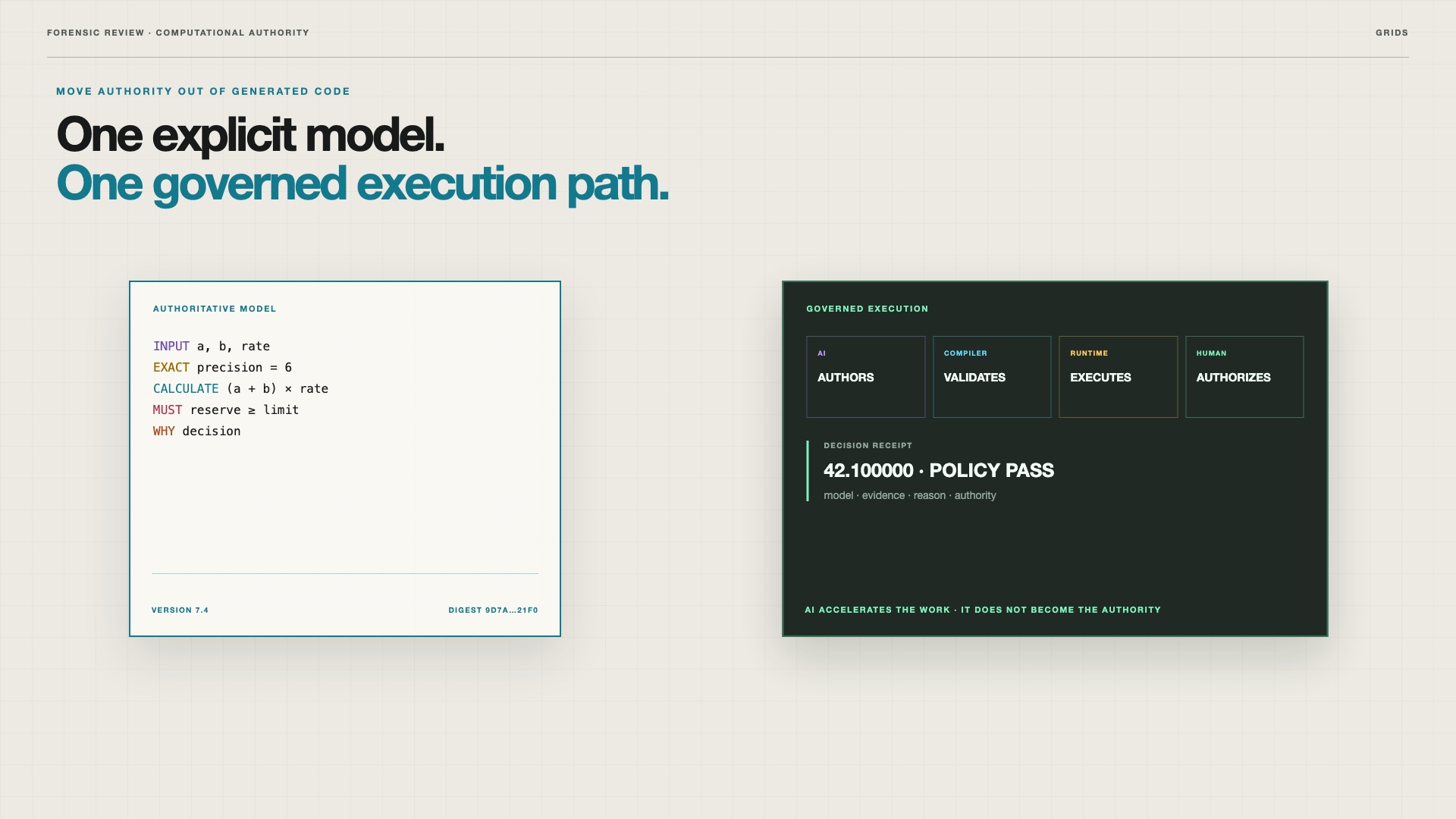
Five AI-written versions of the same requirement return different answers; the film moves the rule into one visible model and keeps approval with a person.
 ▶ 0:40
Guided path · Useful AI, recognizable authority
Let AI propose. Make the model evaluate. Keep a person accountable.
AI can help people express a rule, assemble an option, or explore a decision faster. The governance question begins after generation: which approved facts and rules evaluate the proposal, what can a reviewer inspect, and who has recognized authority to act?
Explore the worked examples and calculations
Commercial credit · A proposed exception
The assistant can assemble the case. It cannot approve the waiver.
A fictional commercial borrower requests a temporary covenant waiver. An AI assistant summarizes the file and proposes a 30-day exception after reviewing an incomplete packet of financial and relationship information.
AI proposal
CREDIT-842.requested_action
- Source
- AI-ASSISTED REVIEW SESSION
- Revision
- DRAFT-A17
- Observed
- 14:20Z
What depends on it
- Attributed proposal
- Approved financial facts
- Covenant and policy rules
- Exposure and exception evaluation
- Credit-owner review
Bounded finding
The represented model marks the proposal conditional because two required facts are stale and one exception exceeds the fictional analyst's approval limit. It produces an inspectable review packet rather than an approval.Evidence record. Retain the source identities and as-of times, AI prompt and attributed output, policy revision, represented calculations and limits, missing information, model revision, reviewer comments, decision, accountable actor, and authorization time.
Claim boundary. Fictional governance illustration. It is not underwriting advice, a lending policy, a fair-lending assessment, a compliance control, a customer outcome, or evidence that an AI-generated recommendation is correct or lawful.
Public program · An award recommendation
Eligibility can be evaluated. Public authority cannot be generated.
A fictional program receives more complete applications than its current funding can support. An AI assistant drafts summaries and proposes an award order using the criteria it infers from guidance and prior review notes.
AI proposal
AWARD-CYCLE-27.recommended_order
- Source
- AI-ASSISTED APPLICATION REVIEW
- Revision
- DRAFT-P08
- Observed
- Cycle close
What depends on it
- Attributed summaries
- Verified application facts
- Approved eligibility rules
- Represented scoring and exceptions
- Program-officer determination
Bounded finding
The represented model identifies two proposed awards that depend on unsupported facts and separates eligibility findings from discretionary scoring. The output is a review queue with reasons, not an award list.Evidence record. Retain application and policy revisions, provenance for extracted facts, AI-generated summaries, represented eligibility and scoring logic, conflicts and missing evidence, human corrections, reviewer identity, final determination, and notice record.
Claim boundary. Fictional illustration, not a benefits or grant determination system, legal interpretation, accessibility review, bias assessment, procurement, public notice, or assurance that the represented criteria are complete or appropriate.
Industrial operations · A maintenance priority
A plausible recommendation still has to survive operating constraints.
A fictional plant assistant reads work orders, sensor summaries, and technician notes, then proposes moving Pump 4 ahead of two scheduled inspections because its language model identifies an apparent failure pattern.
AI proposal
MAINT-205.inspection_priority
- Source
- AI-ASSISTED MAINTENANCE REVIEW
- Revision
- DRAFT-M12
- Observed
- 06:40 local time
What depends on it
- Attributed proposal
- Verified equipment facts
- Safety and operating constraints
- Crew and shutdown feasibility
- Maintenance-controller decision
Bounded finding
The represented model agrees that Pump 4 meets a fictional inspection threshold but shows that the proposed shutdown sequence conflicts with an active safety constraint. It presents two bounded alternatives and the reason each remains conditional.Evidence record. Retain source and sensor revisions, prompt and AI proposal, confirmed equipment identity, applicable procedure and threshold revisions, constraint evaluation, rejected alternatives, technician review, authorization, work record, and any observed outcome.
Claim boundary. Fictional deterministic illustration. It is not equipment diagnosis, safety advice, predictive-maintenance validation, a live integration, an optimization result, or evidence of reduced downtime or risk.
The authority pattern
From AI contribution to accountable decision.
-
Name the decision and its owner
Begin with the consequential action, the person or external process authorized to take it, and the boundary the system must not cross.
One explicit authority contract -
Let AI propose with attribution
Use AI to draft, translate, summarize, or explore while retaining its instructions, context, output revision, and known limits.
One attributable proposal -
Confirm the facts
Resolve important claims to approved sources, identities, revisions, and as-of times. Mark missing, stale, or disputed information instead of letting the proposal fill the gaps.
A reviewable fact set -
Evaluate through the model
Apply explicit calculations, rules, constraints, permissions, and acceptance cases to the proposal through a governed execution path.
Findings with reasons and model revision -
Present an inspectable packet
Show the proposal, facts, rules, alternatives, uncertainty, AI contribution, and what the system can and cannot conclude.
Evidence fit for human judgment -
Authorize and retain the record
Let the accountable person approve, narrow, defer, or reject. Record the actor, authority, time, decision, exceptions, and observed outcome separately.
An attributable decision and history
Continue at your depth
Compare it. Watch it. Read deeper. Build it.
- 01 · Try Compare blurred authority with a governed decision path Follow one AI proposal through facts, explicit evaluation, human authorization, and a durable record. Jump to the authority comparison
- 02 · Watch AI with Human Authority Five AI-written versions of the same requirement return different answers; the film moves the rule into one visible model and keeps approval with a person. Watch the 0:40 film
- 03 · Read AI Can Write the Model. It Should Not Own the Decision. AI makes software easier to create. Consequential work still needs an explicit model, consistent execution, inspectable evidence, and a person with recognized authority. Read the article
- 04 · Build Follow the decision into Grid Continue into the linked Grid Developers guide for the exact behavior, prerequisites, and limits used by this explanation. Build an explainable decision model
Evaluate one AI-assisted decision
Find the point where generated help becomes organizational authority.
Choose one consequential workflow already using or considering AI. Use the assessment to name its proposal, facts, model, review packet, accountable owner, and evidence requirements before expanding automation.
- What exactly may AI propose, and what must it never authorize?
- Which facts, rules, and constraints evaluate the proposal?
- What must the accountable person be able to inspect?
- Which record would let another reviewer reconstruct the decision?
Written analysisRead the full article behind this guided example.
Jump to a section in this publication
Creation is becoming abundant
AI can draft formulas, models, analyses, and applications in minutes. That changes who can begin building and how quickly an idea can become executable.
It does not settle which interpretation should govern, which evidence is sufficient, or who may act.
Ask several systems to implement the same policy and they may choose different defaults, precision, exception handling, or order of operations. Each implementation can look reasonable while producing a different answer. A fluent explanation can conceal those differences as easily as it can reveal them.
Separate contribution, evaluation, and authority
- AI proposes. It can help express rules, assemble an option, summarize evidence, or explore alternatives.
- The model evaluates. It applies approved facts, calculations, rules, constraints, and permissions through a governed execution path.
- A person authorizes. An accountable owner uses the evidence and recognized authority to approve, narrow, defer, or reject the action.
- The record distinguishes them. It retains what was proposed, what was evaluated, what was decided, by whom, and what happened afterward.
This makes AI useful without quietly making generated code, persuasive prose, or interface access the source of organizational authority.
Human authority requires inspectability
A consequential result should carry more than a number or recommendation. The responsible person should be able to inspect the facts, sources, rules, model revision, alternatives, constraints, uncertainty, AI contribution, and reason for the finding.
Human authority is therefore not merely a button at the end. It is a design obligation: give the accountable person enough context, time, permission, and recourse to exercise judgment—including the ability to disagree.
What governance cannot automate
A validated model can still contain a poor policy. A source can still be incomplete. A feasible option can still be unwise. A fully attributable decision can still produce a bad outcome.
Grid can make responsibilities visible, execution consistent, and evidence inspectable. It does not establish legal authority, replace domain expertise, certify fairness, guarantee correctness, or remove the need to observe what happened after action.
Begin with one authority contract
Choose one AI-assisted workflow and write down five things: what AI may propose, which facts and rules evaluate the proposal, what the reviewer must see, who may authorize action, and which evidence must remain after the session ends.
If any answer is only “the AI” or “the application,” the authority design is not yet complete.