Field brief · Defense and government
Grids for Defense and Government
A research-grounded discussion brief on accountable decision models, changing mission facts, interoperability, and human authority.
Government + defense · 1:09
Decision Advantage
Teams use one live model to see what changed, test feasible options, understand why, and keep the final decision with a person.
 ▶ 1:09
Decision advantage is changing course together
The defense problem is not a shortage of dashboards, models, AI pilots, or custom software. It is the distance between new information and coordinated, authorized action.
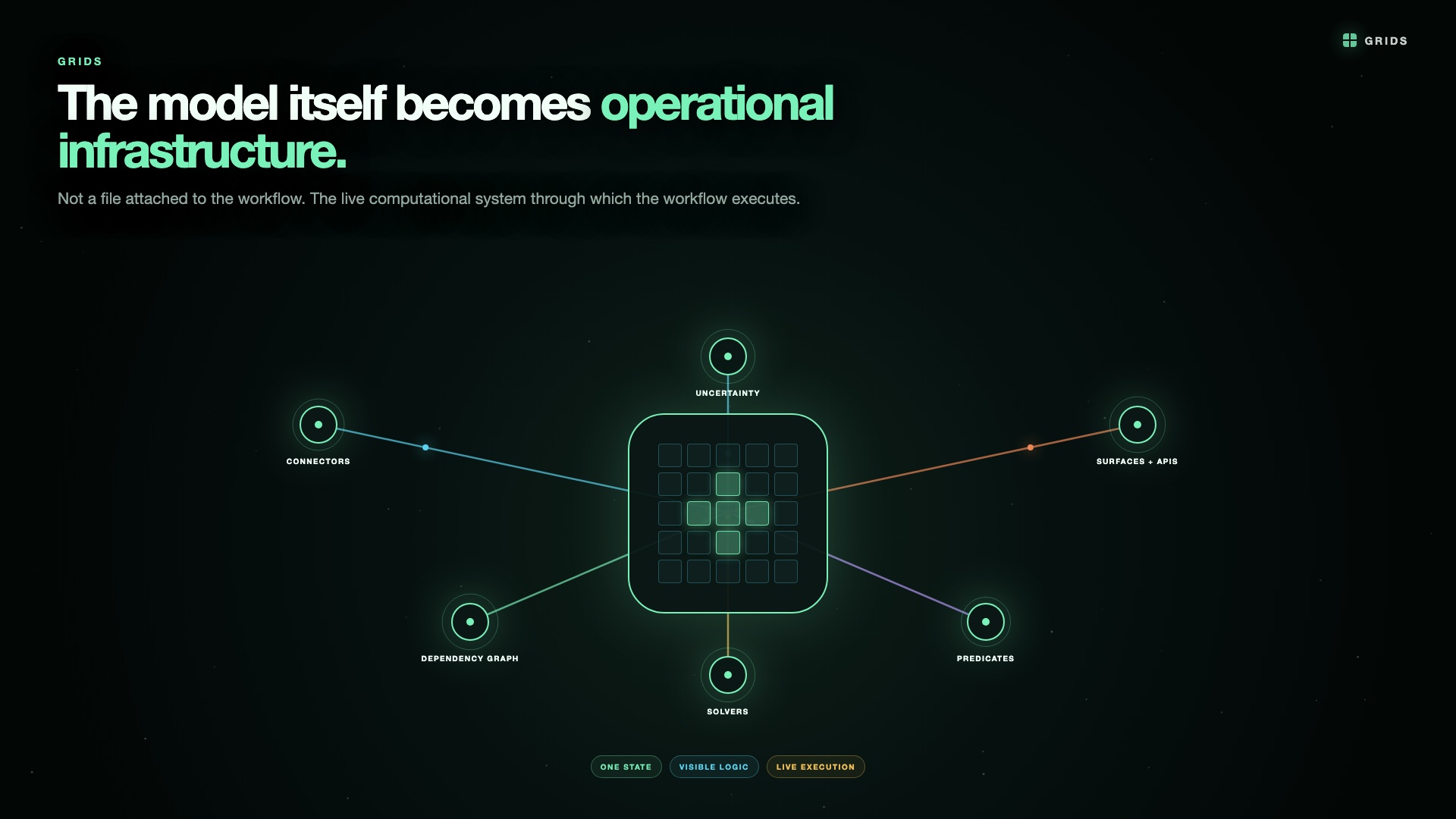
This field brief examines Grid as executable decision infrastructure: a shared computational model that can receive changing information, express mission logic, recalculate affected decisions, evaluate authored alternatives, explain conclusions, and serve multiple interfaces without translating the model into a new application every time.
Questions for a bounded discussion
- What is the authoritative model behind the common operating picture?
- When a source changes, which decisions are known to be affected?
- Can two organizations prove they executed the same mission logic?
- Can an operator inspect why a modeled alternative was rejected?
- Can a partner adopt shared logic without surrendering its data?
- Where does AI-assisted authoring stop and accountable authority begin?
The complete brief includes audience-specific messages, public-source context, evaluation questions, technical interpretation, and explicit claim boundaries.
Related films, scenarios, and next steps
Continue exploring
Follow the next question.
Replan Sustainment When Route and Stock Change
Connect usable stock, movement capacity, time windows, mission demand, and command authority so a changed route or inventory fact produces an inspectable replan rather than another reconciliation cycle.
Understand · PlanSource-grounded ExploreHow Grid Works: From Typed Facts to Accountable Action
A technical and operational guide to the six-stage Grid chain: governed sources, a shared and versioned model, reactive constraint evaluation, coordinated surfaces, explanation and evidence, and AI assistance bounded by human authority.
Understand · EvaluateSource-grounded ExploreCoordinate Coalition Decision Logic Without Centralizing Sovereign Data or Authority
Execute an agreed decision contract in each participant’s environment, exchange only authorized claims and results, and reconcile revisions without letting a shared system assume national release or action authority.
Understand · PlanSource-grounded Explore