Scenario · Capacity Commons governance edition
The Capacity Commons: The Ward That Wrote the Network’s Next Operating Model
A ward rejects an optimistic bed-board label, then works through a cooperative process to make its local operating logic reusable without copying patient data or surrendering local authority.
- What this is
- A published decision scenario. Its setting and values are invented for illustration.
- What this shows
- How declared facts and rules produce a traceable result when conditions change.
- What this does not show
- A customer deployment, measured outcome, or transfer of authority to software.
Narrated film · 1:10
The Ward That Wrote the Network’s Next Operating Model
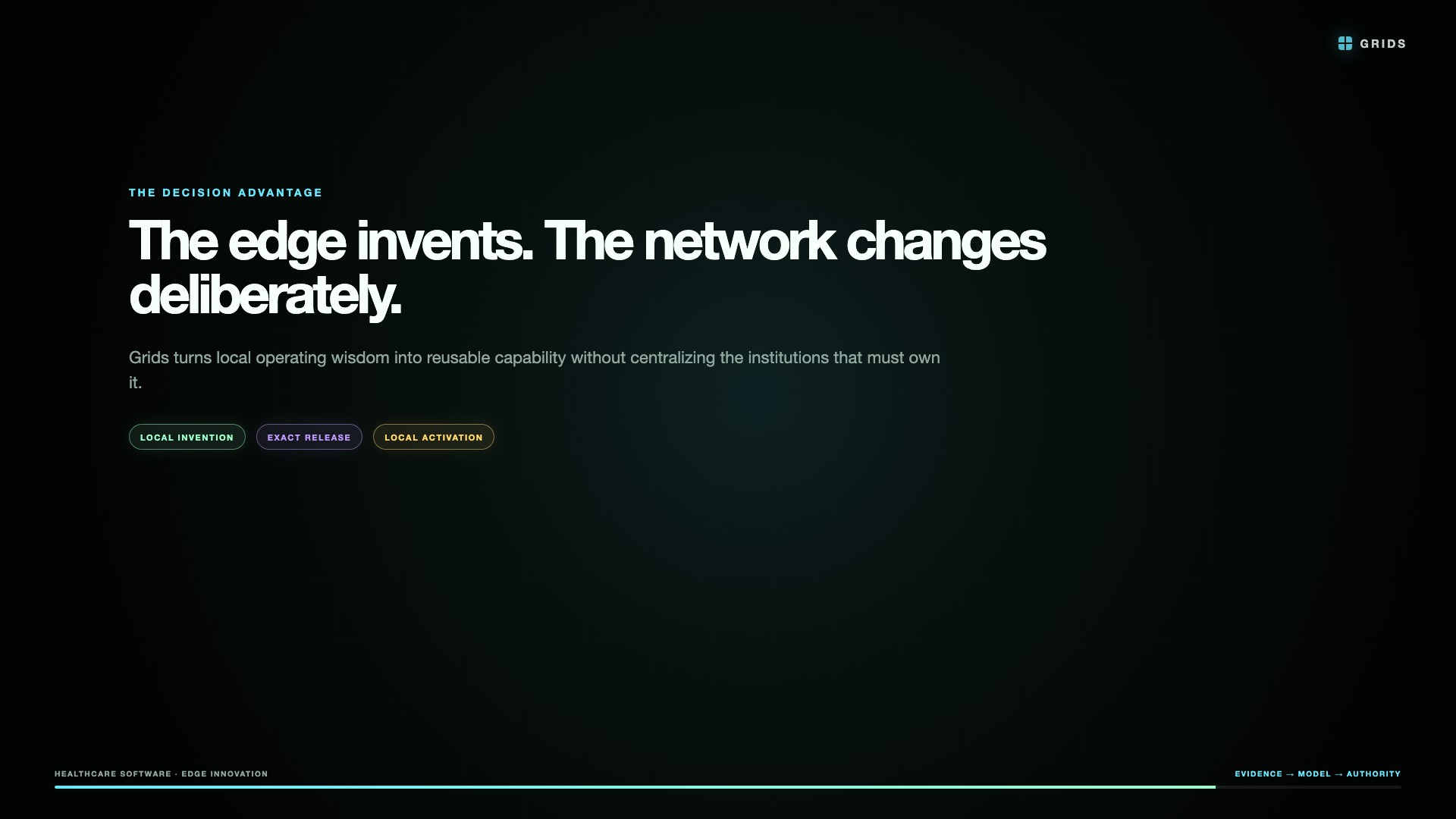
Follow a local administrative improvement through review and reuse, with each organization retaining control of adoption.
 1:10
1:10
Story
Start with the event and the decision it creates.
The companion story
Nine months earlier — “expected” is not a state
Every Friday afternoon, Alder 6's bed board becomes optimistic. At 3:10 it shows two expected discharges. By 6:00, one prescription is still in the pharmacy queue, a home-oxygen order has been accepted but has no delivery window, the accessible transport pool is serving recurring dialysis reservations, and environmental services cannot yet promise when the second room will turn.
The board is not wrong about the clinical decisions entered into it. It is wrong about what those decisions mean operationally. Rosa Alvarez, the ward's flow coordinator, writes four words on a whiteboard for Maya Chen, an operational-systems analyst: Expected is not a state.
The operating edition of The Capacity Commons follows the ice-storm morning that comes nine months later. This companion begins with Rosa's refusal and asks how the useful local model beneath that morning can travel without copying the ward, centralizing its facts, or granting a network office authority it does not possess.
Over the next two weeks, Maya authors a small local Grid model called Alder Turn. Rosa supplies the operating logic and rejects every shortcut that would turn a clinical or patient-owned decision into an administrative assumption.
Clinical clearance, the patient's accepted plan, pharmacy completion, equipment confirmation, transport availability, and room-turn state remain separate predicates with their own owners, observations, and expiry times. The local model represents the dependency chain after clinical and patient decisions. It does not make those decisions.
The ward team sees different views of the same model. Rosa works from a board and calendar. Pharmacy sees its queue. Environmental services sees room-turn dependencies. The flow director sees a compact operating surface. Those are presentations, not healthcare authorization; surrounding hospital systems must enforce identity, access, and purpose of use.
By week four, the model publishes one small conclusion: an aggregate service category, quantity, expected interval, valid-through time, evidence state, binding reason, and source revision. Patient rows do not have to leave the hospital for that declaration to participate in a hospital model. The full local history and exceptions remain at their authoritative home.
Month two — the cooperative does not rewrite the ward
Alder Turn becomes useful. Another hospital asks for it. The practical question comes before the product vocabulary: how can another site reuse the useful structure without receiving Alder 6's records, inheriting every local assumption, or taking authority away from its own operators?
The invented Lakebridge Regional Care Cooperative does not rebuild the model centrally or distribute copies that can drift. Maya's authored model and Rosa's operating logic continue running under ward control while a joint team creates an inactive reusable package, called a candidate Grid Solution. This is deliberate product work, not a one-click export from a live workspace.
The candidate begins with a precise capacity-promise contract: shared definitions for category, quantity, effective interval, evidence state, binding reason, and source revision. It also contains reusable time and dependency modules, starter templates, permitted source mappings, read-only source-system rules, workflow boundaries, role and quorum requirements, rollback obligations, role-specific experiences, and synthetic tests for missing, stale, duplicate, corrected, and conflicting facts.
The reusable contract is not Rosa's complete model. It does not contain Alder 6's patients, credentials, local source data, history, secrets, or every ward exception. It is the part of the work the cooperative believes another institution should be able to map and test.
Month three — review before signing
The cooperative's Software and Data Council does not own or command its members. It operates shared contracts, qualification rules, trust anchors, and an internal release registry under agreements the members have already made. Product, domain, privacy, security, and operations reviewers examine the candidate. They run conformance and qualification cases, compare it with the prior release, and flag changes that expand authority or break a contract.
Only after that review does an operator-controlled process build and sign an exact package. Its version and cryptographic digest give it a stable identity that a consuming model may pin. A catalog update cannot silently rewrite a ward.
The distinction among release, installation, migration, and activation is deliberate. Signing says an exact candidate passed a defined cooperative process. It does not say every site must use it. Installation makes the package available. A site-specific mapping connects it to local sources. An approved migration changes a local model. Activation remains a separate decision by the accountable member.
Month five — North Shore joins without becoming a copy
At North Shore Community Hospital, systems lead Priya Nwosu selects the reviewed release from the cooperative catalog. Her deployment operator verifies its signature and exact package identity. North Shore's accountable owner independently approves installation; that approval does not authorize operational activation. Priya maps the templates to North Shore's own read-only sources, runs the supplied tests plus local cases, and creates a new model home pinned to the exact release.
Priya next prepares one selected, structured capacity promise for publication into North Shore's hospital model. But the story supplies no separate activation decision or activation record. It therefore establishes a mapped and tested installation, not an active operating deployment; installation itself did not confer operational authority. No Alder 6 facts arrive with the software. No North Shore patient rows flow back to Alder 6. The two sites have the same reviewed contract mapped to different local realities, while each remains authoritative for its own facts, mappings, policies, operator surfaces, and activation state.
Grid primitives can make the package exact and inspectable. The story does not claim that Grid currently supplies a turnkey health-system fleet service for staged rollout, limited trials, monitoring, and rollback across every node. Lakebridge would have to operate that campaign with additional controls.
Month nine — the shared contract meets regional pressure
Nine months after Alder Turn's first local version, freezing rain raises regional demand and the cooperative stress-tests the shared contract. Alder 6 contributes a current promise. North Shore's mapped installation contributes a test promise without being treated as an active production source. Because the story supplies no activation record, the North Shore contribution establishes contract compatibility, not operating authority. The regional model can compare category, quantity, interval, evidence state, and expiry because those are shared semantics. It cannot reach backward through the contract and operate either hospital.
When ordinary source changes make an Alder 6 promise conditional, that bounded conclusion changes through the ward, hospital, and regional dependency path. North Shore's unrelated state remains its own. The common contract creates comparable evidence, not a centralized institution.
The companion story meets the operating edition here: four current units, several conditional ones, and a regional plan that stops at external owners. The administrative achievement happened earlier. Local work was turned into a reusable starting point without pretending that reuse means identical implementation or shared authority.
The next release comes from the rural edge
After the pressure event, analysts notice how often accessible transport windows bind capacity. Pine Valley Critical Access Hospital already has a small local model protecting recurring dialysis service. Pine Valley and the Council's software stewards extract one reusable idea: describe a transport window as a time-qualified, owner-controlled promise with declared capacity, purpose, release conditions, and expiration.
They add generic modules, negative cases, workflow rules, role governance, migration intent, and qualification evidence. Because the new workflow expands the kinds of governed action represented by the package, it receives the corresponding review before signing. The next cooperative release originates at a 25-bed rural hospital, not the Council office.
Pine Valley keeps the carrier calendar, travel assumptions, operating exceptions, local views, and sensitive records that make its model work. The network receives only the general contract approved through its defined review process. Other members decide whether to install, map, and activate it.
That is the administrative fabric: the work closest to the problem writes the first draft of the software; the network makes reuse accountable through explicit contracts, tests, review, exact releases, and local choice. The ward invents locally. The cooperative changes deliberately. Neither becomes the other's authority.
Where the model stops
Grid can represent revisions, mappings, tests, explanations, and release states. It cannot decide that a local invention is safe, lawful, clinically appropriate, or authorized everywhere. Signing proves an exact package passed a defined release process; it does not confer another site's activation authority.
What remains to prove
A controlled evaluation would need real governance roles, privacy and security review, package integrity, distribution and rollback, site-specific conformance fixtures, operator experience, and retained activation evidence. This public Scenario remains a related edition—not a duplicate account of the regional operating story.
Decision path
Follow the changed fact step by step.
A calculation, proposal, approval, execution report, and outcome are different events. The order keeps those boundaries visible.
- 01 · Month zero
Alder 6 replaces an ambiguous state
The ward refuses to treat expected discharge as one unqualified value.
- 02 · Week two
The ward authors a local dependency chain
Staff, tasks, time, equipment, and accountable ownership become inspectable.
- 03 · Week four
A narrow promise crosses the boundary
The ward shares a typed contract rather than its complete local model or patient records.
- 04 · Month two
The cooperative extracts a candidate Solution
Reusable structure is packaged as an inactive candidate with explicit assumptions.
- 05 · Month three
Conformance and authority review precede signing
Product, domain, security, and operations reviewers test the candidate before release.
- 06 · Month five
A second site installs without becoming a copy
The receiving site maps its own sources, policies, and surfaces; installation still does not establish activation authority.
- 07 · Month nine
Regional stress tests the shared contract
Comparable promises coordinate without centralizing all underlying facts.
- 08 · Next cycle
The next reusable release originates at another edge
Governed contribution becomes a network habit rather than a one-way center-to-edge flow.
Evidence and limits
What the scenario represents—and what real-world use still requires.
Represented in this scenario
- Local models and narrow reusable contracts with separate revisions
- Mapping, conformance, review, signing, installation, and activation states
- Comparable regional promises without copying every local record
Required integration and operating work
- Health-network governance, identity, privacy, signing, distribution, and rollback controls
- Site-specific source mappings, validation, operator review, and activation evidence
Decisions that remain with people and institutions
- Automatic promotion of a local model to a network release
- Unreviewed installation or activation at another site
- Clinical decisions or patient-level information exchange
Evidence, authority, and publication recordView the scenario contract, capability record, authority stages, verification status, and related work.
Scenario contract
The setting, trigger, decision, and authority boundary.
- Setting
- An invented ward whose local operational model becomes a candidate reusable contract for a health cooperative.
- Timeframe
- Nine months before a regional stress event through the next cooperative release
- Trigger
- A ward rejects an ambiguous expected-discharge state and authors a more accountable local dependency model.
- Decision
- How can local invention become reusable across a network without copying the ward, centralizing every fact, or bypassing local activation authority?
- Authority
- Local teams author and activate their own mapped models; product, domain, security, and operational reviewers govern reusable releases.
From edge invention to governed reuse
Reuse the contract, not the institution.
The edition separates local authoring, candidate extraction, network review, site mapping, and local activation.
- SourcesWard-owned operational facts
Local systems and accountable owners remain the source of each represented fact.
- ModelReusable typed contract
A narrow interface and its assumptions are extracted from the local model.
- ReviewInactive governed candidate
Conformance, product, domain, privacy, and operational checks precede release.
- Local authoritySite mapping and activation
Each receiving site decides whether and how to activate its mapped model.
- External evidenceVersioned release and activation records
Signing, delivery, installation, and activation remain separately attributable.
What is established
What is documented, what this scenario combines, and what still needs testing.
This separates documented capabilities from authored combinations in the scenario. Neither proves a complete deployment or outcome.
Documented building blocks
Capabilities described in maintained Grid documentation or another named source.
- Reviewed product primitives document local models, typed contracts, exact package identities, qualification tests, and signed installation; this is not healthcare qualification or deployment evidence.
- Reviewed product primitives document selected-value exchange, model-bound surfaces, and governed-workflow evidence; they do not establish a cooperative release service.
Combined in this scenario
Capability combinations represented in this scenario that still require end-to-end evaluation.
- The authored design composes a ward dependency model, narrow reusable contract, conformance review, signed release, and site-specific mapping.
- Network-owned privacy, trust, rollout, rollback, and local activation controls would turn that sequence into an administrative fabric.
Not yet proved
Integration, operating, policy, or evidence work that is not complete.
- A turnkey workspace-to-Solution promotion path and health-system fleet control plane remain missing.
- An executable fixture, cross-site conformance proof, qualified healthcare integrations, and operator validation remain outstanding.
Proof and limits
What this scenario supports—and what remains to validate.
These states describe the scenario source and its defined checks. Real-world validation requires separate evidence.
- Scenario publication
- PublishedReleased August 27, 2026 as an operating scenario.
- Source readiness
- R2 · Sources reviewedDomain support and product capability boundaries have been reviewed.
- Scenario check
- Checks not runScenario revision 2026-08-27.1 defines the steps and expected results; the checks have not run yet.
- Independent review
- PendingThe expected results have not received independent review.
- Deployment evidence
- NoneNo customer deployment, production performance, or real-world outcome is claimed.
- Next proof required
- Advance beyond R2Run the defined checks, retain the results, and have an independent reviewer check the expected results.
Evidence and stewardship
What supports this scenario—and when it must be reviewed again.
Illustrative evidence
Authored governance scenario grounded by public medical-coordination and de-identification sources; it is not evidence of a deployed health network or an approved clinical model.
Invented elements. The ward, cooperative, release process, timings, and outcomes are authored; public sources ground only coordination governance and privacy concepts.
- Owner
- Grid FYI Editorial
- Reviewed
- August 27, 2026
- Review due
- February 27, 2027
- Source revision
- 2026-08-26.3
- Scenario package
- capacity-commons-administrative-fabric
Related work
Related reading and examples.
These links are chosen as direct companions to this scenario.