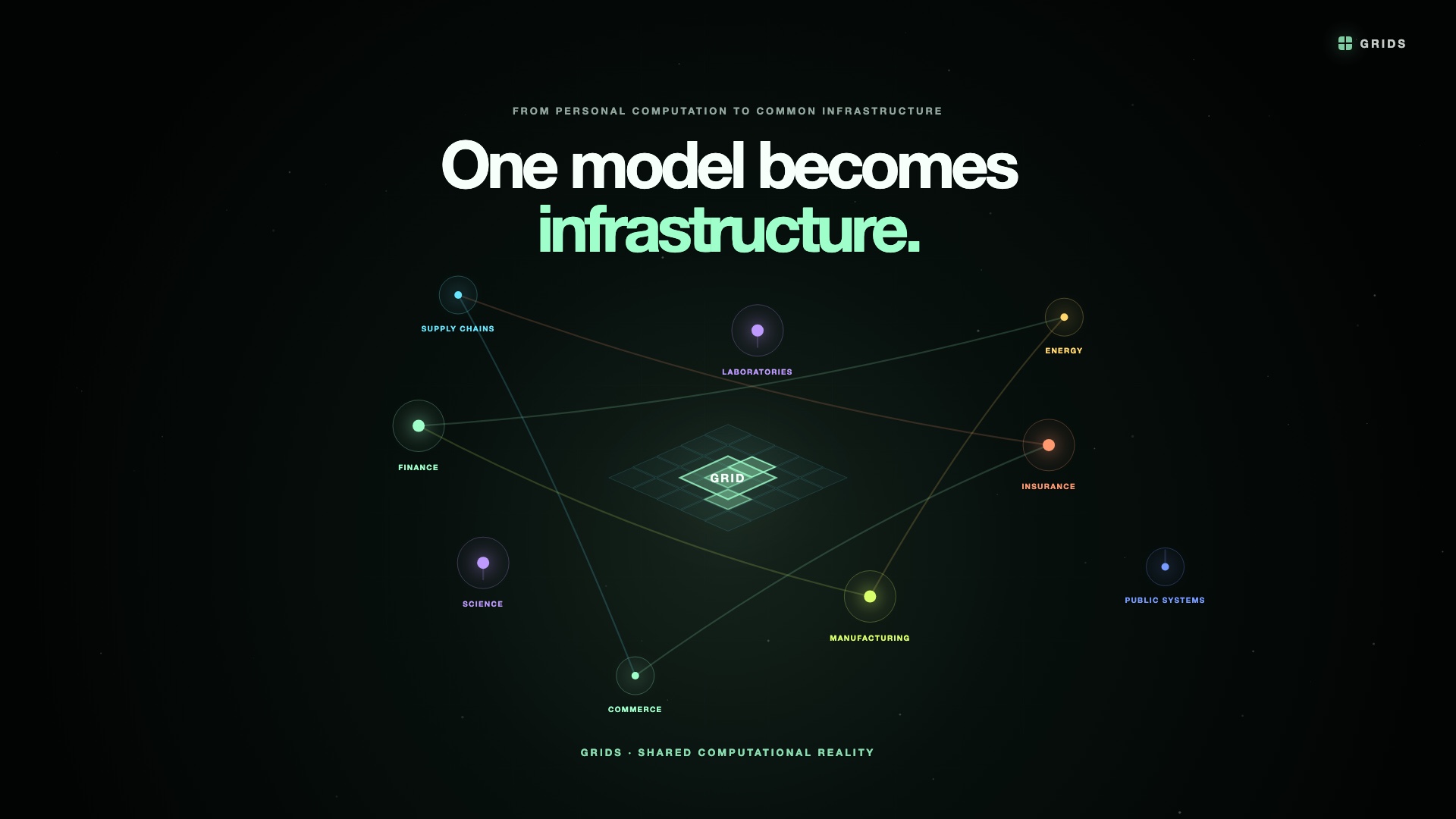
How Grid works

One fact changes. Every dependent result follows.

A model is the facts, rules, and calculations behind a decision. Grid gives that model one shared home, updates the right results when a fact changes, and keeps every approved view aligned.

It can calculate and explain. The people and systems with real authority still decide and act.

Change one factRead the complete guide

Manufacturing explainer · 1:30

What Is Grids?

A changed manufacturing fact breaks a six-company plan; Grids shows what still works while commitments, quality, and execution remain in human hands.

Watch film · 1:30 Follow one example
▶ 1:30

Interactive planning scenario

One fewer transport makes the plan infeasible.

Six required movements take forty minutes per wave. When available transport falls from six to five, the work needs two waves and misses an 08:45 window.

  1. Source revision6 → 5LOGISTICS.available_transport · L-442
  2. Dependency1 → 2 wavesceil(6 required ÷ available)
  3. Completion08:40 → 09:20Z40 minutes per wave
  4. Constraint+5 → −35 min08:45Z window
  5. Plan stateFeasible → infeasibleThe earlier and current states are both retained

The changed fact updates the wave count, completion time, remaining margin, and feasibility state. A predefined alternative can be checked next.

Nothing here reallocates a real vehicle, changes an order, or grants authority. Those actions still require the responsible person and evidence from the external system.

Change the source fact yourself
Explore the six jobs behind the model

One model · Six jobs

A clear chain from source to decision.

Each step has a specific job. If a source, rule, or authority is unclear at one step, a polished interface later in the chain cannot fix it.

  1. 01

    Connect each fact to its source

    Keep the producer, time, revision, unit, and permitted use attached to every important input.

    What you can check
    A reviewer can identify the exact accepted input and the contract at its boundary.
    What this does not prove
    Successful receipt does not prove that a source is true, current, authoritative, or fit for the decision.
    Read the source and model architecture
  2. 02

    Put the rules in one shared model

    Represent the facts, formulas, dependencies, constraints, tests, owners, and revisions in one reviewable place.

    What you can check
    Different participants can point to the same represented logic instead of reconciling private implementations.
    What this does not prove
    A shared model does not require one database, one interface, one security domain, or one decision authority.
    Follow the private-copy transition
  3. 03

    Recalculate when facts change

    Update the results that depend on a changed fact, keep unrelated state stable, and show when a plan no longer works.

    What you can check
    A controlled revision changes the expected results while unrelated state remains stable.
    What this does not prove
    A recalculated or feasible option is not selected, approved, funded, released, or executed.
    Trace one changed fact
  4. 04

    Give each role the right view

    Present sheets, maps, documents, applications, reports, or APIs from the same current model without copying the calculation.

    What you can check
    Different interfaces can be tested for semantic parity even when their layouts and permitted fields differ.
    What this does not prove
    Coordinated does not mean identical, and it does not entitle every audience to every source or result.
    See one rule across many surfaces
  5. 05

    Show why the result changed

    Expose the important inputs, rules, dependency path, constraints, warnings, and retained history needed to review the result.

    What you can check
    Given retained source, model, and runtime identities plus committed history, a qualified reviewer can reproduce why the represented conclusion moved.
    What this does not prove
    An explanation is not automatically complete, correct, independently validated, or sufficient for a regulated decision.
    Use the evaluation gates
  6. 06

    Keep the decision with a person

    Let software and AI draft, calculate, compare, and explain without turning a proposal into an approval or real-world action.

    What you can check
    The record distinguishes machine contribution, human review, accepted model revision, and the actor holding the decision right.
    What this does not prove
    Authentication, a recommendation, or access to an action does not itself confer legal, clinical, financial, command, or release authority.
    Inspect the authority contract
Evidence and limitsWhat can a practical test actually show?

A successful source connection, calculation, interface, or approval screen should not inherit a larger claim than its evidence supports. See the full evidence model.

LayerInspectA small test can showIt cannot show by itself
SourceIdentity, revision, time, unit, validation, correctionThe exact value accepted by the fixtureTruth, authority, completeness, or fitness for use
ModelNames, formulas, dependencies, constraints, tests, versionExecution fidelity for declared casesThat policy, doctrine, science, or judgment is substantively correct
EvaluationAffected path, alternatives, uncertainty, infeasibilityExpected change propagation under stated conditionsSelection, permission, operational suitability, or effect
SurfaceAudience, fields, transformation, revision, release ruleSemantic parity across the tested viewsUniversal access, accessibility conformance, or workflow adoption
ExplanationInputs, intermediate values, rules, history, evidence linksReconstruction by the named reviewerIndependent validation, legal sufficiency, or complete causality
AuthorityRole, scope, delegation, reviewed revision, recorded actThat the fixture enforced its represented boundaryReal-world authority, authorization to operate, or an achieved outcome

Continue

Try it, read more, or evaluate it.

Choose the shortest path that answers the question you have now.

For developersBuild the same path with Grid.

These guides cover the product concepts, source connections, first model, explanation tools, views, external functions, examples, and production planning.

  1. 01

    Learn the product vocabulary

    Workbook, model, binding, cell, symbol, formula, predicate, rule, connector, and surface.

  2. 02

    Connect governed source events

    Inspect connector ingress, event admission, bindings, idempotency, backpressure, and the boundary between receipt and source truth.

  3. 03

    Build a first reactive model

    Create typed inputs and named derivations, then prove the dependency graph by changing one value.

  4. 04

    Explain and validate a decision

    Trace dependencies, compare saved state, keep uncertainty distinct, and test authored write contracts.

  5. 05

    Project workbook surfaces

    Study how sheets and purpose-built surfaces present model-backed state without becoming separate calculation systems.

  6. 06

    Bound external effects

    Separate host-admitted network or secret capability from the institutional authorization behind a consequential act.

  7. 07

    Verify an executable fixture

    Use declared source, expected output, and verification contracts to make a narrow behavior claim repeatable.

  8. 08

    Inspect canonical source

    Use small runnable examples and their expected outputs as implementation references—not as proof of deployment suitability.

  9. 09

    Plan the operating boundary

    Review production concerns and preserve the difference between a documented runtime path and an authorized deployment.