Connect a production promise.
Represent supplier commitments, qualified capacity, and dependencies together. Test a changed fact before a revised promise becomes a commitment.
Explore the manufacturing scenarioGRID AT MADE IN AMERICA
Contested logistics puts every assumption under pressure. Grid gives the facts, constraints, and rules behind a shared plan one reviewable model—so people can see what changed, test the consequences, and decide what happens next.
A LOGISTICS STORY · 53 SECONDS
Scattered inventory is only useful when its availability can be established. Follow the evidence into a proposed medical-resupply route, with approval remaining with the responsible officer.
An illustrative scenario about evidence and authority, not a report of an operational deployment.
THE CONVERSATION WE ARE BRINGING
Represent supplier commitments, qualified capacity, and dependencies together. Test a changed fact before a revised promise becomes a commitment.
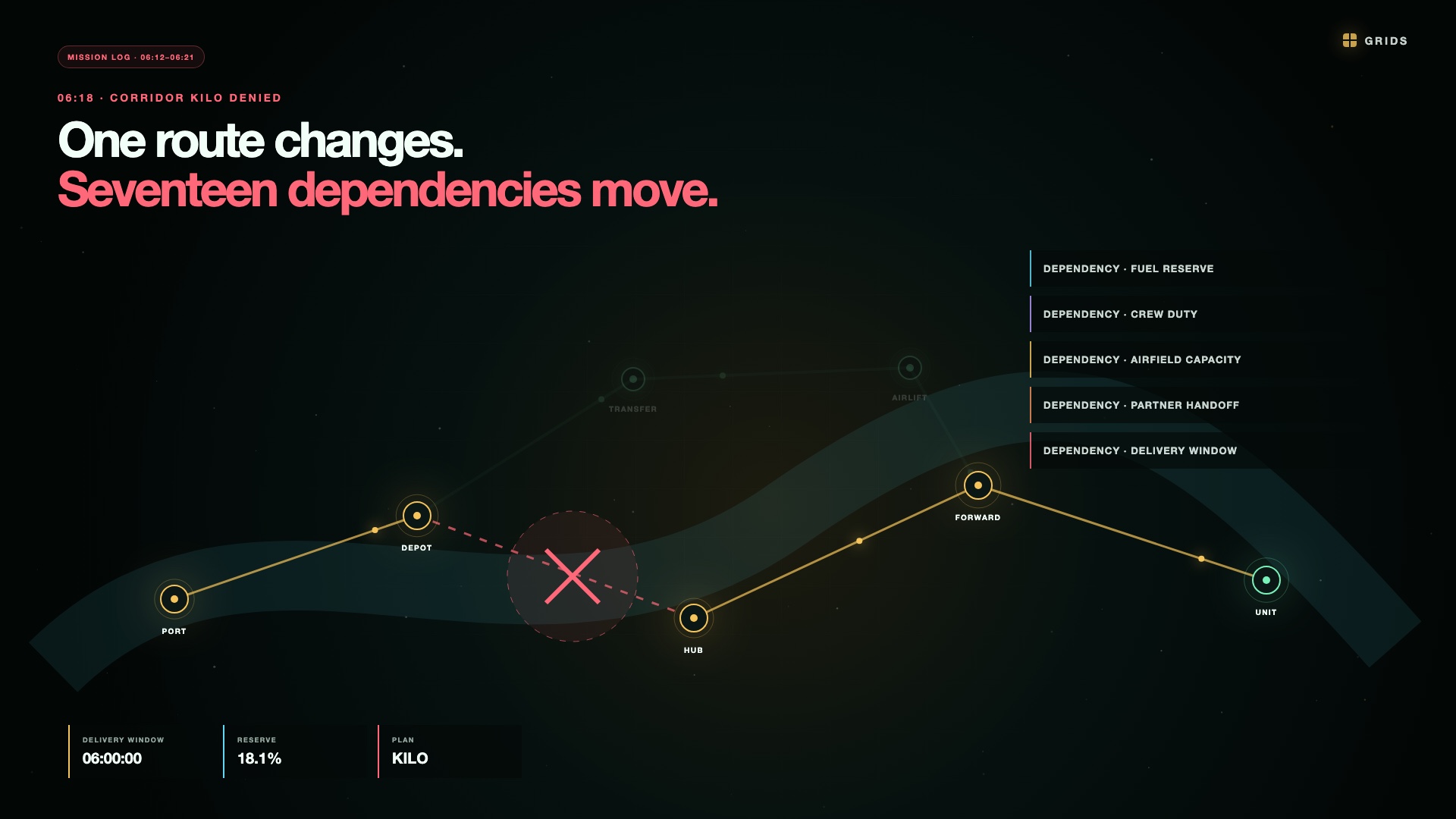
Explore the manufacturing scenarioA lost transport can invalidate a plan that looked sound a moment ago. Trace the affected work and compare bounded alternatives against the same current facts.
Try changing one transportMake sources, rules, and assumptions inspectable. A modeled option is evidence for review; reservations, commitments, and execution still require their own authority.
Explore AI with human authorityWHY THIS ROOM
The University of Arkansas’ Contested Logistics Consortium connects research with defense and industry practice. Its work includes supply-chain resilience, network optimization, and decision support under disruption. Explore the consortium
STATION NWA connects entrepreneurship in manufacturing, supply chain, and logistics with Capital Factory’s national network. Grid’s focus for this conversation is the decision model that connects participants while preserving their separate responsibilities. About STATION NWA
MEET GRID
A useful conversation starts with the facts that change, the teams that need to respond, and who can authorize the next step.
Please use unclassified, non-controlled examples.